

The choice between obstetrics and nursing affects not only the next few years of study, but also the pace of future work, the scope of responsibility and the nature of the relationships built with patients. Both courses require empathy, resilience and very specific practical training. Over time, more day-to-day questions will also arise: what footwear to wear for clinical sessions, or whether you need your own ladies' medical blouse and which uniform will allow for comfortable work over many hours. The most important decision, however, should stem not from the name of the degree course or preconceptions about the profession, but from an understanding of the actual duties of a nurse and a midwife.
In short: nursing offers a wide choice of specialisations, wards and patient groups, whereas midwifery focuses primarily on women's health, pregnancy, childbirth, the postnatal period, newborn care and selected areas of gynaecology. Neither of these fields is easier by definition. They differ in their profile of responsibility, working environment and the moments in which the specialist accompanies the patient.
In this guide, we compare both paths without reducing them to stereotypes. We show the reality of day-to-day studying, internships, and subsequent work, and we also provide tips on how to identify the path best suited to your own predispositions.
Midwifery or nursing degree – the most important difference in a nutshell
A nurse can work with patients of various ages in many areas of healthcare: from paediatrics and surgery, through internal medicine, intensive care and psychiatry, to long-term, community or outpatient care. A midwife specialises in the care of women and newborns, particularly during pregnancy, childbirth and the postnatal period, but her role does not end in the delivery room. It also encompasses prevention, health education and participation in gynaecological care.
If you are interested in medicine in the broad sense and want to keep the option of changing your area of work, nursing usually offers more diverse pathways. If you are particularly drawn to issues of women's health, the physiology of pregnancy, childbirth, lactation and newborn care, midwifery may be a more natural choice.
However, this is only the starting point. The final decision should take into account:
- the groups of patients you wish to work with,
- the type of responsibility you are willing to accept,
- emergency response procedure,
- willingness to work shifts and night shifts,
- emotional resilience,
- an interest in specific fields of medicine,
- the need for diversity or specialisation,
- preferred patient contact model.
Midwifery and nursing – a comparison of courses of study
| Area | Nursing | Obstetrics |
|---|---|---|
| Main patient group | Patients of all ages | Women, pregnant women, mothers and newborns |
| Scope of topics | Broad, covering many fields of medicine | Focused on women's health, pregnancy, childbirth, the postnatal period and the newborn |
| Typical work placement locations | Hospital wards, outpatients' clinics, primary care, long-term care | Delivery theatres, maternity, gynaecology and neonatal wards, outpatient clinics |
| Possibilities of later specialisation | Very wide | More targeted, yet still diverse |
| Nature of the relationship with the patient | From brief interventions to long-term care | Often, intensive care at a pivotal moment in one’s life |
| Emergencies | They are found in many specialities | They may affect both the mother and the child at the same time |
| Key interests | General medicine, procedures, observation, education and care | Women's health, reproduction, childbirth, the postnatal period, lactation and the newborn |
The table simplifies the issue, as much depends on the specific role. A nurse working in primary healthcare has a different daily routine to an anaesthetic nurse. Similarly, the work of a community midwife differs significantly from a shift in the delivery theatre. It is therefore worth considering not only the degree programme itself, but also the specialisations and professional settings available after graduation.
What does a nursing degree involve?
The nursing degree programme combines the study of human physiology, diseases and treatment with intensive training in direct patient care. The programme includes both theoretical subjects and practical sessions, medical simulations and clinical placements.
Students learn to assess a patient’s condition, identify nursing issues, plan care, carry out procedures safely and respond appropriately to any deterioration in the patient’s condition. Communication is also an important part of the training: with the patient, their relatives and the entire healthcare team.
What subjects can you expect?
The names and structure of courses vary from one university to another, but they usually include, amongst other things:
- anatomy and physiology,
- pathology,
- pharmacology,
- fundamentals of nursing,
- internal medicine and medical nursing,
- surgery and surgical nursing,
- Paediatrics,
- geriatrics,
- neurology,
- psychiatry,
- long-term care,
- primary health care,
- anaesthetics and intensive care,
- paramedics and emergencies,
- public health,
- psychology and communication,
- professional ethics,
- scientific research and evidence-based practice.
This does not mean that a graduate has to know right from the start in which field she wants to specialise. One of the greatest advantages of nursing is precisely the opportunity to explore different areas during clinical placements.
What are the work placements like?
Nursing placements teach how to function in a real healthcare environment. The student learns ward organisation, documentation, safety rules and team communication. Gradually, under supervision, she moves from observation to performing procedures in accordance with her stage of education.
In practice, this may mean, among other things:
- help with daily patient care,
- taking measurements and monitoring vital signs,
- preparing the workspace,
- learning the principles of medication administration,
- carrying out selected procedures under supervision,
- documenting completed activities,
- patient education regarding recommendations,
- responding to a change in health status,
- cooperation with doctors, physiotherapists, carers and other nurses.
A first placement can be stressful, as theory begins to be combined with responsibility for another person. It is only then that many female students discover whether they feel at home in the fast-paced hospital environment, or whether they prefer the calmer pace of an outpatient clinic or long-term care.
Who is nursing a good choice for?
Nursing is worth considering if you’re interested in a broad range of medical fields and don’t yet want to limit yourself to a single group of patients. It’s a good course of study for people who enjoy combining analysis, practical work and interacting with people.
They are particularly useful:
Flexibility
A shift rarely goes entirely to plan. A patient's condition can change, a new person may be admitted to the ward, and priorities need to be quickly reordered. A nurse should be able to adapt their approach without losing accuracy.
Mindfulness
A slight change in behaviour, breathing, skin colour or measurement results can be significant. Good observation is not just about „looking”, but about connecting information and reporting concerning signs.
Ability to work as part of a team
Healthcare is not a field for lone specialists. Safe care requires clear communication, the sharing of information and respect for the expertise of individual team members.
Mental resilience
The nurse meets people who are suffering, frightened, sometimes demanding or grieving. Empathy is essential, but the ability to maintain boundaries and recover after work becomes equally important.
Willingness to learn
Medical knowledge, procedures and standards are constantly evolving. Graduating from university does not mark the end of one’s education, but provides a foundation for further professional development.
Nursing may not be the best choice if you handle contact with illness very badly, are not ready for responsibility or expect exclusively predictable working hours. This does not mean, however, that every nurse works on a heavy hospital ward. The profession offers various employment models, and some of them have a more regular rhythm.
What do midwifery studies involve?
Midwifery studies prepare students for professional care of women at various stages of life, with a particular focus on reproductive health, pregnancy, childbirth, the postnatal period and newborn care. It is a highly specialised field requiring medical knowledge, practical skills and emotional maturity simultaneously.
A midwife is not a „nurse who assists at births”. She is a representative of a distinct, regulated profession with her own scope of competence and responsibility. She accompanies a woman not only during the birth of the child, but also in prevention, education, preparation for motherhood, the postnatal period, breastfeeding and selected areas of gynaecological care.
What subjects can you expect?
Depending on the university’s programme, female students will learn, amongst other things:
- anatomy and physiology,
- embryology and prenatal development,
- basics of obstetrics,
- care of a woman with a normal and complicated pregnancy,
- care during labour,
- postnatal care,
- neonatology,
- gynecology,
- pharmacology,
- paediatrics,
- health promotion and disease prevention,
- fundamentals of nursing,
- lactation,
- psychology,
- communication with the female patient and her family,
- ethics and professional law,
- management of emergencies.
The field requires a thorough understanding of physiology, but is not limited to a normally progressing pregnancy. The student also learns to recognise signs that may indicate a threat to the health of the mother or child.
What are midwifery placements like?
Placements may take place, amongst other places, in maternity, gynaecology and neonatal wards, in delivery theatres, antenatal clinics and community care settings. Interaction with patients can be very emotionally intense. The birth of a child can be a joyful occasion, but midwives also encounter complicated pregnancies, difficult births, anxiety, pain and loss.
Depending on the stage of her education, the female student can:
- monitor the course of pregnancy and childbirth,
- to learn how to assess the condition of a woman and her newborn baby,
- to assist in preparing the delivery room,
- learn the rules for keeping records,
- to support a woman during childbirth,
- to teach how to communicate effectively with the woman in labour and her loved ones,
- to help look after a newborn baby,
- take part in training on the postnatal period and breastfeeding,
- observe the care of gynaecological patients,
- to learn about the work of a community midwife.
This is a field for people who can keep calm in a situation involving simultaneous strong emotions, pain, time pressure and responsibility for the health of more than one person.
Who would benefit from studying obstetrics?
Midwifery may be the right path if you are genuinely interested in women's health, rather than it merely „seeming like a nice specialisation”. A fascination with birth is a good start, but you also need to see the full picture of the profession.
In this work, the following are particularly important:
Calm and composure
Labour may proceed normally, but the situation can change rapidly. The midwife must remain alert and ready to act, even when the patient and her family are experiencing intense anxiety.
The ability to build trust
A midwife's contact with a woman concerns very personal, often intimate issues. The method of communication, respect for boundaries and the patient's sense of security are of great importance.
Mature empathy
Supporting a female patient does not mean making promises that cannot be kept. Empathy in the medical profession combines warmth with reliable information and responsibility.
Interest in female physiology
If topics concerning pregnancy, childbirth, gynaecology, the newborn and lactation are truly interesting to you, it will be easier for you to maintain motivation during demanding studies.
Resilience in the face of difficult experiences
Not every story ends as the family expects. A midwife should also be able to professionally support patients experiencing complications or loss.
Obstetrics may prove too narrow a specialism for someone who would like to work regularly with different groups of patients and frequently switch between medical specialities. If, on the other hand, you are keen on a specialised role in women’s healthcare, this focus will be an advantage.
Which is more difficult: nursing or midwifery?
There is no objective answer, because the difficulty of each degree course has a different character. Nursing requires the acquisition of a wide range of knowledge concerning many conditions and patient groups. Midwifery is more focused, but involves responsibility in dynamic situations concerning both the woman and the child.
Nursing can be more difficult for someone who struggles to cope with frequent changes in the type of tasks. Midwifery can be more difficult for someone who is deeply affected by situations related to childbirth, complications or pregnancy loss.
The following will appear in both directions:
- study of anatomy, physiology and pharmacology,
- practical assessments,
- classes in simulated conditions,
- clinical placements,
- exposure to suffering and stress,
- the need to balance university studies with an irregular timetable,
- self-assessment of communication skills,
- responsibility for compliance with procedures.
It is therefore worth asking not „which direction is easier?”, but „which type of difficulty makes more sense to me?”.
Scope of responsibilities in daily work
Perceptions of medical professions are often formed on the basis of brief observations, television series or social media accounts. Reality involves significantly more paperwork, organisation, communication and responsibility.
A nurse's daily life
Depending on the place of employment, the day may include receiving a handover report, assessing patients, carrying out orders, preparing for examinations, administering medication in accordance with one's qualifications and procedures, changing dressings, taking samples, providing education, documenting actions, and responding to a deterioration in health.
Different tasks will dominate on a surgical ward than in a diabetes clinic, psychiatry or home care. The common denominator remains responsible observation of the patient and coordination of many elements of care.
The everyday life of a midwife
A midwife can provide antenatal education, support a pregnant woman, care for a woman in labour, monitor the progress of birth, participate in initial newborn care, help initiate breastfeeding and support the family during the postnatal period. In gynaecology, she also works with women who are not pregnant.
A community midwife has a different work rhythm to a specialist on the delivery suite. The former more frequently conducts education and postnatal home visits, while the latter operates in an environment requiring constant readiness for a rapidly developing situation.
Nursing or midwifery – where are there greater job opportunities?
Nursing offers a very broad spectrum of employment settings. A graduate can develop in hospital, outpatient, community and long-term care, prevention, education and many clinical specialities.
Sample areas include:
- internal medicine wards,
- surgery,
- Paediatrics,
- intensive care,
- anaesthesiology,
- psychiatry,
- neurology,
- cardiology,
- oncology,
- geriatric care,
- primary health care,
- home care,
- occupational medicine,
- specialist clinics,
- health education,
- clinical trials.
Midwifery is more specialised, but also allows for different working models. Midwives work in a range of settings, including:
- in delivery theatres,
- in maternity wards,
- in pregnancy-related pathology,
- in gynaecology,
- in neonatal units,
- in clinics,
- in community care,
- in antenatal classes,
- in lactation education,
- in women's health prevention,
- at fertility clinics,
- in vocational education and science.
If you’re looking for maximum flexibility and the opportunity to make significant changes during your career, nursing has the edge. If you want to develop your career consistently in the care of women and newborns, the specialist nature of midwifery may be an advantage.
How to choose a degree course suited to your personality?
Popular aptitude tests can be helpful, but they shouldn’t make the decision for you. An honest analysis of specific situations yields better results.
Ask yourself the following questions:
- Do I want to work exclusively or primarily with women and newborns?
- Am I more interested in general medicine or reproductive health?
- How do I react when several tasks require my attention at the same time?
- Am I able to talk calmly to someone who is in pain and feeling anxious?
- Am I willing to work shifts, at weekends and on public holidays?
- How do I experience contact with serious illness, death or loss?
- Do I want to be able to move between very different fields?
- Am I also interested in working at a birth even when it does not go according to plan?
- Can I accept feedback and improve the way I perform a task?
- Am I ready to regularly update my knowledge after graduating?
An honest answer doesn't have to sound perfect. Resilience, communication and organisation can be developed. However, you cannot build lasting satisfaction solely on the prestige of a profession or the expectations of others.
How do you check the direction before the first stage of document processing?
The best decision is made based on contact with reality, not just the description on the university's website.
Compare specific university programmes
Check:
- programme of study,
- the number and type of placements,
- clinical base,
- simulation centre equipment,
- travel to facilities,
- the way lessons are organised,
- entry requirements,
- feedback on support during internships.
Courses must meet the relevant standards, but universities differ in terms of their organisation, facilities and teaching culture.
Have a chat with current students and graduates
Don’t just ask whether the course is „cool”. Better questions are:
- What was the biggest surprise?
- What was your first interaction with the patient like?
- How long does it take to get to the work placement?
- Which classes are the most challenging?
- How does the university respond to difficulties encountered during work placements?
- Would you still choose this course after the lessons?
- In which field would you like to work after graduating?
Take advantage of our open days
Take a look at the laboratories and the simulation centre, ask about work placement opportunities, and have a chat with the lecturers. The atmosphere at a single open day does not determine the quality of the course, but it does help you assess whether the teaching approach suits your needs.
Look for opportunities to shadow professionals
If you have the opportunity, have a chat with a practising nurse or midwife. Even a candid discussion about a typical shift can tell you more than a promotional description of the course.
Women’s medical tops and practical training uniforms – what really matters?
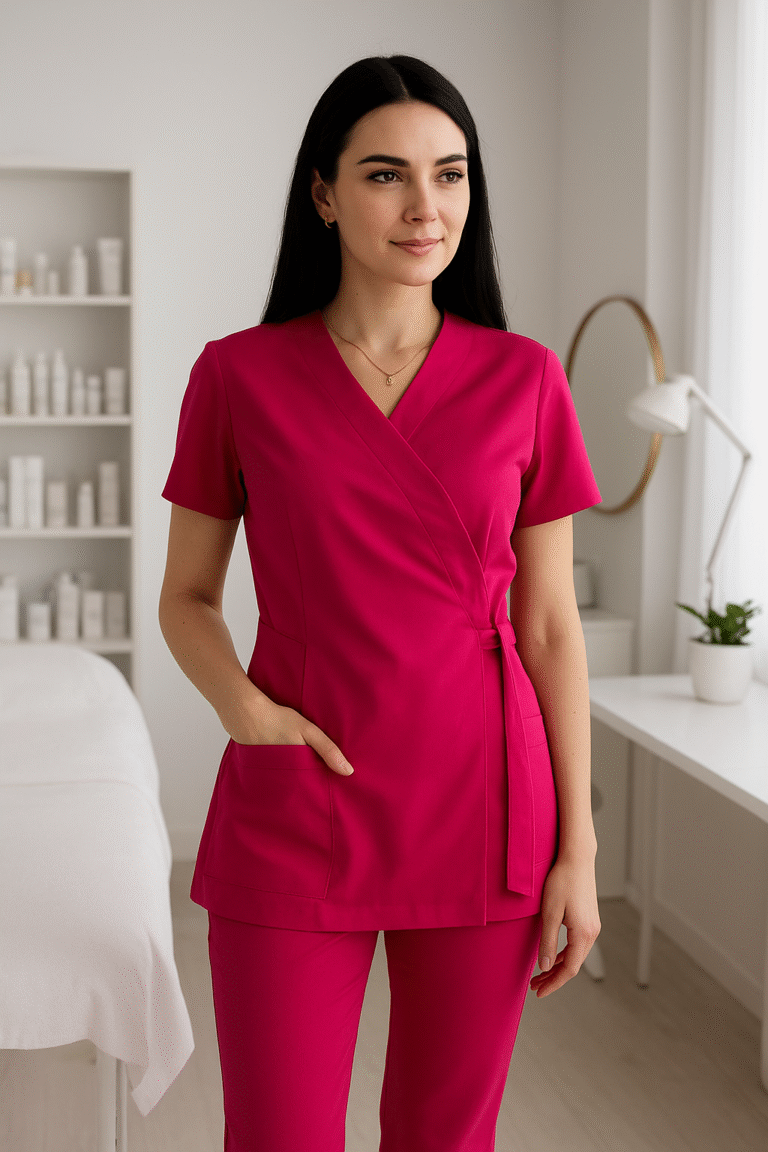
Your clothing does not determine whether you will be a good professional, but inappropriate attire can effectively make it difficult to cope with long hours of work. During clinical placements, you’ll be carrying out a lot of different movements: bending over, changing position, raising your arms, moving quickly between wards and working at a patient’s bedside. That’s why Sweater women's medical It should be assessed primarily in terms of ergonomics.
Not every university allows female students to choose the colour or style themselves. Before making a purchase, check the work placement regulations, the supervisor’s requirements and the rules of the specific institution. A specific colour, embroidery, ID badge or a kit provided by the university may be required.
If you’re free to choose your own outfit, there are a few things to bear in mind.
Freedom of movement
The sweatshirt should not feel tight across the back when you stretch your arms out, nor should it ride up excessively when you bend over. The cut must allow for freedom of movement around the shoulders, shoulder blades and chest, whilst not being so loose that the fabric catches on equipment.
Well-designed medical scrubs for women they accommodate the proportions of the female silhouette, but do not restrict the range of movement. A fit should not mean constriction.
Breathability and thermal comfort
At university, you might spend a few hours in a lecture theatre, whilst on work placements you might be on the move all day. The fabric should ensure thermal comfort and wick away moisture effectively. The thinness of the fabric alone is not necessarily an indication of its breathability or quality.
It is worth verifying:
- composition of the material,
- the way the fabric behaves after washing,
- level of flexibility,
- colour fastness,
- degree of transparency,
- ease of removing creases,
- the manufacturer’s care instructions.
Functional pockets
A student may not always have their mobile phone with them, but pockets are still needed for small accessories permitted by the institution. They should be positioned so that they can be reached comfortably without having to make any awkward movements.
Pockets that are too shallow are inconvenient, and if overloaded, they can distort the sweatshirt. It is worth looking for a compromise between capacity and structural stability.
Appropriate length
The top should stay in place when bending over and raising your arms. A model that is too short may expose the lower back, while one that is too long will restrict movement in the hips. The correct length depends on height, body proportions, and the cut of the trousers.
An aesthetic appropriate for the profession
A professional look does not have to mean a shapeless uniform. Carefully tailored cuts, an aesthetic finish and a well-chosen colour allow you to look elegant without losing functionality.
This is particularly important in places where the female specialist builds a longer relationship with a female patient or client. Neat medical uniform it supports the first impression, but should remain a discreet backdrop to competence.
How to choose women's medical trousers?
It is not just the top that determines the comfort of the set. A well-fitted ladies' medical trousers they should allow you to sit down freely, squat, bend over and take a longer stride.
The most important elements are:
- comfortable belt that doesn't pinch during hours of work,
- the right rise,
- space in the hips and thighs,
- no excessive sliding during movement,
- functional pockets,
- length tailored to height,
- material resistant to frequent washing,
- a cut that doesn’t hinder quick movement.
Jogger-style trousers are popular due to their sporty comfort and the cuffs that hold the legs in place. However, not every workplace likes the same style, so it is worth checking the dress code first.
The trousers and top should form a cohesive set, not just in terms of colour. If the top and bottom are made of materials with a different shade or sheen, the whole outfit can look accidental. Ready medical scrubs for women they solve this problem and make putting together outfits for the coming days easier.
How many sets of clothing are needed for the work placement?
At first, it is not worth buying many sets without knowing the university's requirements. A sensible order is as follows:
- Check the official terms and conditions.
- Determine the required colour and markings.
- Ask if the costume has to be from a specific supplier.
- Find out about the work placement timetable.
- Buy your first set and test it out on the move.
- Decide on the subsequent sets only later.
If training sessions take place over several consecutive days, a single uniform will usually not be sufficient for organisational and hygiene reasons. However, the exact number depends on laundry facilities, the rules and regulations, and the frequency of sessions.
Before removing the tags, perform a simple test on the outfit:
- Raise your hands.,
- cross them in front of you,
- bend down,
- sit down,
- do a squat,
- take a long stride,
- put small accessories in your pocket,
- check the sweatshirt and trousers under different lighting.
If the material pulls, is see-through, shifts excessively or requires constant adjusting, the problem is likely to become more noticeable during your shift.
Is the uniform worn by a nursing student different from that worn by a midwifery student?
In terms of design, both courses have similar needs: freedom of movement, pockets, thermal comfort, easy care and compliance with regulations. Differences arise more often from the requirements of the university or specific institution than from the name of the course itself.
On some degree programmes a uniform colour is compulsory for the whole year group, while on others it differs by course of study. Sometimes a classic cut is required, on other occasions modern ones are permissible. medical scrubs.
Therefore, one should not assume that the uniform seen on a student from another university will also be accepted at yours. Regulations first, purchase later.
Once you’ve finished your studies, there’s often a wider range of choices. At that point, a stylish outfit can become part of your professional image — particularly in private practices, clinics, medical centres and the beauty industry.
Most common mistakes when choosing a degree subject
Selection based on a single subject
Good results in biology help, but they do not determine readiness for contact with a patient. Similarly, difficulty with chemistry does not automatically mean that you won't cope at university. What counts is your overall aptitude and readiness for systematic study.
The idealisation of childbirth
Obstetrics is sometimes presented solely through the prism of joyful births. In reality, it involves pain, uncertainty, complications, surgeries, illnesses, and losses. The choice of specialisation should also take these elements into account.
Equating nursing solely with the hospital
Nurses work in many settings. If you do not see yourself in a traditional ward, it does not mean that the entire profession is unsuitable for you.
Being guided solely by family opinion
Loved ones can help organise arguments, but they won't take part in placements for you or work shifts. The final decision should belong to the person who will bear the consequences.
Choice based solely on earnings
Financial conditions are important, but they depend on the workplace, working hours, on-call shifts, qualifications and many other factors. Remuneration is worth analysing, but it should not be the sole criterion for a long-term career path.
Buying equipment before checking the regulations
Even the highest quality clothing will be of no use during work placements if it is an unauthorised colour. Always check the university's requirements first.
What should you do if you still can't choose?
Just because you’re not immediately sure doesn’t mean you’re not suited to either course. Both careers are equally valid, so making a responsible decision takes time.
Complete four steps:
1. Write down your priorities
Divide the piece of paper into three parts:
- What I expect from this job,
- what I definitely want to avoid,
- what difficulties I am ready to work with.
Do not just enter general terms like „helping people”. Replace them with specifics, for example, „I want to work with women”, „I care about the opportunity to change specialisation” or „I function well in a dynamic environment”.
2. Compare actual programs
Check the nursing and midwifery curriculum at the same universities. Pay attention to which subjects spark genuine curiosity in you and which you only accept as a necessary chore.
3. Carry out two conversations
Talk to one nurse and one midwife. Ask them to describe a difficult and a rewarding day. Do not ask which profession is „better”, as the answer will depend on personal experience.
Imagine not your first, but your tenth year at work
The first few months of university are important, but your career will last much longer. Consider in which area you still see room for development after a few years.
Can you change path after one degree?
Both professions have their own educational standards and qualifications. Completing one field of study does not automatically grant the right to practice the other profession. A person wishing to acquire separate qualifications must meet the requirements set for the chosen field and profession.
However, one can develop in areas that partially overlap, such as health education, family care, prevention or selected clinical issues. The scope of specific activities always depends on the qualifications held and applicable regulations.
That is why it is not worth choosing nursing on the assumption that it will be „almost the same” as midwifery — nor the other way round. They are distinct professions.
How to prepare for the first year?
The first year often requires a change in the way you study. There is a lot of material, and simply memorising definitions is not enough. You need to understand relationships and learn how to perform procedures safely.
It may be helpful:
- regular revision of anatomy and physiology,
- creating short notes after every class,
- learning in small groups,
- communication exercise during a simulation,
- using reliable textbooks and recommendations,
- asking questions to the presenters,
- looking after sleep before practical classes,
- preparing clothing and equipment the previous day,
- maintaining the schedule of placements and credit assessments,
- accepting that manual dexterity develops gradually.
At this stage, an aesthetic uniform is not the most important element of preparation, but comfortable clothing reduces minor issues during classes. When your top doesn't restrict your shoulders, your trousers stay in place, and you can fit the things you need in your pockets, it's easier to focus your attention on learning.
How to build a professional image while still on an internship?
Professionalism does not come from the price of an outfit or a perfect styling. It is created above all by behaviour, preparation and respect for the patient.
The female student builds trust through:
- Punctuality,
- proper hygiene,
- neat, regulation uniform,
- short and neat nails,
- complying with jewellery restrictions,
- introducing your role,
- patient privacy protection,
- active listening,
- acknowledging when one cannot yet do something,
- performing activities solely within the permitted scope,
- requesting supervision,
- correct communication of information.
Well-designed clothing can support this image, but it will never replace competence. At Scrabme, that is precisely why aesthetics are combined with ergonomics: professional attire should look elegant and at the same time function during the actual working day.
Midwifery or nursing – the ultimate criterion of choice
Choose nursing if:
- you are interested in many fields of medicine,
- you want to work with patients of various ages,
- you value the opportunity to change your specialisation,
- you function well with a variety of tasks,
- you don't have another chosen field yet,
- you see yourself in a hospital, clinic, general practice or community care.
Consider midwifery if:
- you are particularly interested in women's health,
- you want to work with pregnant women, women in labour, mothers and newborns,
- you are fascinated by the physiology of pregnancy and childbirth,
- you can keep calm under strong emotions,
- you accept the specialised nature of the profession,
- you see yourself in a delivery suite, gynaecology, neonatology or community care for women and children.
If both descriptions suit you to a similar degree, conversations with practitioners and analysis of the syllabuses will be key. Choose not the course whose description sounds nicer, but the one whose everyday reality you are prepared to embrace even on a difficult day.
Summary: midwifery or nursing degree?
Nursing is a broader degree and allows you to work with patients of various ages and in many fields of medicine. Midwifery focuses on women's health, pregnancy, childbirth, the postnatal period, newborns and gynaecological care. Both professions are autonomous, responsible and require continuous development of knowledge.
The best choice does not stem from comparing prestige or from asking which speciality is easier. It should be the answer to three matters: with whom you want to work, which area of medicine genuinely interests you, and what kind of responsibility you are prepared to accept.
When the decision is made, the preparation for classes will become much more practical. Then, appropriately chosen ladies' medical blouse, comfortable trousers and a fitted uniform can support freedom of movement and a professional look. Collections Scrabme they are designed with women in mind who do not want to choose between ergonomics and aesthetics — even when they are just starting out on their professional path.
FAQ – Frequently asked questions
What to choose: nursing or midwifery?
Choose nursing if you care about a broad range of medicine, working with various patient groups and the opportunity to change specialization. Midwifery will be better suited if you are particularly interested in women's health, pregnancy, childbirth, the postnatal period and newborn care.
Can a midwife work as a nurse?
These are two separate, regulated professions. Completing midwifery does not automatically grant nursing qualifications, just as completing nursing does not grant the qualifications of a midwife. The scope of work should be in accordance with the education held and the licence to practise.
Is midwifery harder than nursing?
It is not possible to point to one objectively more difficult course of study. Nursing covers a broader range of fields and patient groups. Midwifery is more specialised and requires readiness to work in dynamic situations concerning the health of both woman and child.
What clothes should I buy for my first internship?
First, check the requirements of the university and the facility. If you can choose your own attire, look for a uniform that provides freedom of movement, an appropriate length, functional pockets, non-see-through fabric, and comfort during hours-long classes.
Are women's medical scrubs suitable for both fields of study?
Yes, provided their colour and design comply with the regulations of the university or institution. Both nursing and midwifery students need clothing that is comfortable, durable, functional and easy to care for.