
Sight. The sense that provides us with more than 80% information about the world around us. For most people, it is a window on the world. But for medical professionals - whether doctors, surgeons, dentists, nurses or cosmetologists - sight is more than that. It is a precise working tool, on which the health and often the life of the patient depends.
Imagine a surgeon who, after 6 hours of surgery, the image starts to „float”. Or a dentist who is unable to see the nuances in a tooth canal due to eye fatigue. In these professions, visual efficiency is as crucial as sterility of instruments or clinical expertise.
However, we live in times that are unforgiving to our eyes. Monitor screens, artificial lighting in operating theatres, air-conditioning, long hours of focusing at close distances - all these contribute to an epidemic of visual fatigue.
This article is not a collection of trite advice along the lines of „eat a carrot”. It is comprehensive guide after visual hygiene, work ergonomics and a holistic approach to health, in which even your dress makes a difference to the quality of your vision.
Chapter 1: Enemy Number One - Digital Vision Fatigue (CVS)
Before moving on to solutions, we need to define the problem. In medicine it is called Computer Vision Syndrome (CVS), or Digital Vision Fatigue. It does not just affect IT professionals. It affects the doctor describing tests on a computer, the nurse entering data into a system or the medical receptionist.
Why are screens destroying us?
Our eyes were evolutionarily designed to look into the distance, at three-dimensional objects that reflect sunlight. Screens are flat sources of artificial light that we stare at from an unnaturally close distance.
The main sins of working with a monitor (and smartphone) are:
- No blinking: Normally, we blink about 15-20 times per minute. In front of a screen, this number drops to 5-7 times. The result? The tear film dries out, the cornea is not moisturised, there is a burning sensation and a feeling of „sand under the eyelids”.
- Accomodation at full speed: The eye's ciliary muscle needs to be constantly stretched to keep close-up vision sharp. It's like holding a dumbbell in your outstretched hand for eight hours. Eventually, the muscle „lets go” and the image blurs.
- Blue Light (HEV): The screens emit high-energy blue light that penetrates all the way to the retina, which can accelerate macular degeneration (AMD) and disrupt the diurnal rhythm (sleep problems).
Chapter 2: Ergonomics of Procedural Work - Eyes of the Surgeon and Cosmetologist
Working at a computer is one thing, but treatment work is a completely different category of strain. A dentist bending over a patient, a vascular surgeon suturing microscopic vessels, a cosmetologist applying permanent make-up - this is where the focus on detail.
Lighting: Key to Precision
Too little light forces the eyes to work hard. Too strong (reflections from surgical instruments) causes glare.
- Council: If you are working with precision, ensure you have shadow-free lighting with a high colour rendering index (CRI). The colour of the light should be neutral (approx. 4000-5000K) in order not to tire the eyes and to realistically reflect the colour of the tissue.
Hospital Dry Eye Syndrome
Hospitals and clinics are specific environments. With air conditioning running 24/7 and ventilation systems, humidity is drastically low. For the eyes, this is a disaster.
- Council: Moisturisation is key. Preservative-free eye drops (artificial tears) should be in every medic's pocket, right next to a pen and stamp.
Chapter 3: A Holistic Approach - What does a medical outfit have in common with Sight?
Here we come to a point that is often overlooked, but is crucial in ergonomics. The body is an interconnected system of vessels. The quality of your vision depends on the tension of your body.
Do an experiment: clench your teeth tightly and stretch your neck. Now try reading a small text. It's harder, isn't it? Tension of the shoulder and neck muscles impairs blood flow to the head and eyes, which directly affects the quality of vision and faster visual fatigue.
The Role of Physical Comfort
If your medical suit is uncomfortable, stiff, drinks under your arms or presses on your waist, your body subconsciously adopts a forced, tense position.
- Neck tension: A stiff, inflexible blouse restricts shoulder movement. To compensate for this lack of mobility during surgery, you tighten your neck. This leads to headaches and visual disturbances.
- Overheating: If your medical uniform does not breathe (it is made of cheap polyester with no viscose added), the body overheats. Dehydration progresses faster and this means poorer tear film quality.
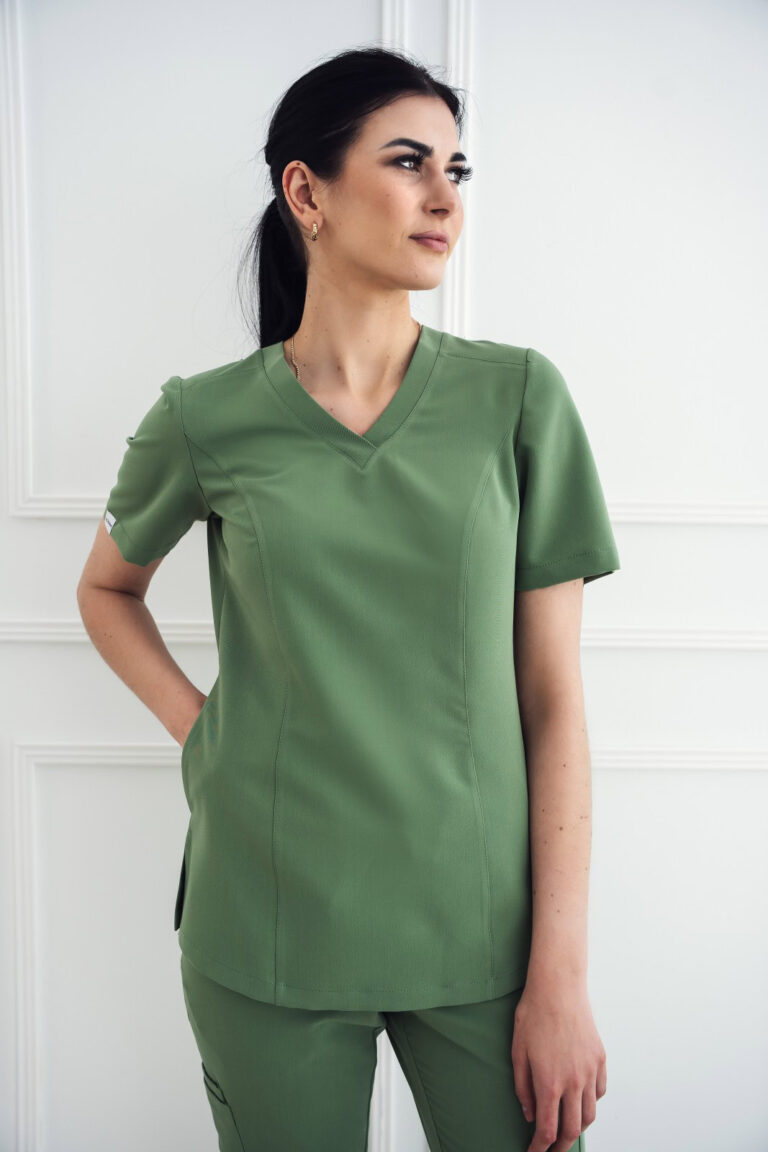
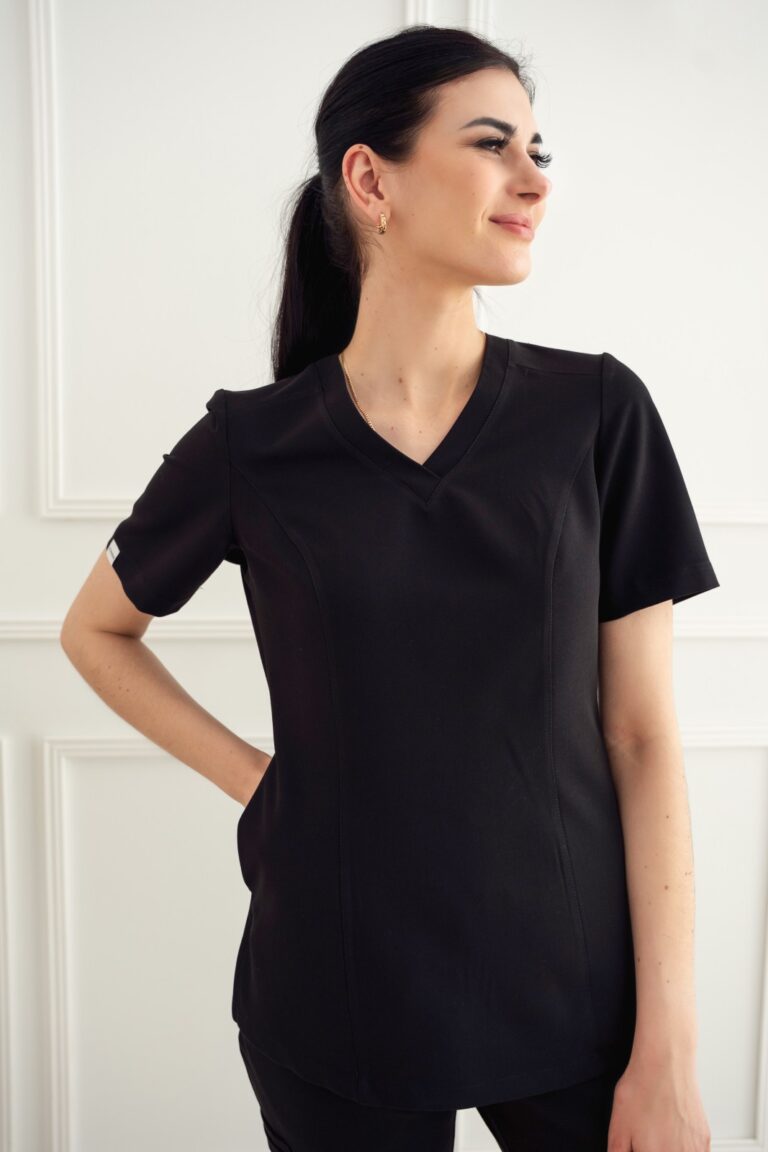
This is why at Scrabme we place so much emphasis on material science. Our scrubs with elastane and viscose allow the body full freedom.
- When you are wearing a flexible medical uniform, your shoulders are slack.
- When the shoulders are loose, the neck is not tense.
- When the neck is relaxed, blood circulation to the eyes is optimal and you can see better and maintain concentration for longer.
Investment in professional medical suit is an investment in whole-body ergonomics - including your eyes.
Chapter 4: The 20-20-20 Principle and Eye Yoga
Your eyes need a gym and... a spa. The oculomotor muscles, like the biceps, need training and relaxation.
Golden Rule 20-20-20
This is the simplest and most effective technique for people working with their eyes.
- What 20 minutes...
- ...look at an object at a minimum distance. 20 feet (approx. 6 metres)...
- ...for at least 20 seconds.
This resets the accommodation of the eye. It allows the ciliary muscle to „let go” of tension. If you're in surgery and can't do this, try at least for a moment to move your gaze away from the surgical field to the wall of the room.
Micro-training for the treatment
- Eights: Imagine a large number 8 on the wall. Run your eyes along it (without moving your head!) one way and then the other. This makes your muscles more flexible.
- Palming (Darkroom): Warm up your hands by rubbing them together. Close your eyes and cover them with the inside of your palms (without pressing the eyeballs!). Darkness and warmth give immediate relief to tired retinas. Do this in between patients.
- Blink Conscious: Blink lightly and quickly for one minute. This naturally massages and moisturises the cornea.
Chapter 5: Diet for the Eyes - Feed Your Retina
Sight is a photochemical process. You need „fuel” and „protection” for it to occur. Your diet has a gigantic impact on how quickly your eyes age.
1. Lutein and Zeaxanthin - Sunglasses from the Middle
These are pigments (carotenoids) that accumulate in the macula of the eye. They act as a natural filter to protect against blue and UV light.
- Where to look: Kale, spinach, broccoli, parsley, egg yolks.
- Tip: They are fat soluble, so drizzle the salad with olive oil!
2. Omega-3 fatty acids (DHA)
DHA acid is a building block of cell membranes in the retina. Its deficiency leads to Dry Eye Syndrome.
- Where to look: Oily marine fish (salmon, mackerel), walnuts, linseed oil, flaxseed.
3 Vitamin A - Queen of Vision
It is essential for the production of rhodopsin, the pigment responsible for vision after dark. Its absence is „night blindness”.
- Where to look: Carrots, yams, pumpkin, liver.
4. antioxidants (Vitamins C and E)
The eyes are constantly bombarded with light, which generates free radicals. Antioxidants are a protective shield.
- Where to look: Citrus, peppers, currants (Vit. C), vegetable oils, almonds (Vit. E).
Chapter 6: Prevention - When was the last time you visited an ophthalmologist?
It is a rhetorical question that hurts. We medics often take the worst care of our own health. „A cobbler walks without shoes”.
An eye test once every two years is an absolute minimum, even if you think your vision is great. Many eye diseases (like glaucoma - the silent zł thief of sight) develop for years without symptoms, destroying the optic nerve. By the time you notice visual field loss, it is too late to reverse the changes.
The examination should not only include „letter reading” (visual acuity), but more importantly:
- Measurement of intraocular pressure (tonometry).
- Evaluation of the fundus (condition of the retina, macula and optic nerve).
- Slit-lamp assessment of the anterior segment of the eye.
Chapter 7: Spectacles - More Than Correction
If you work at a computer or in harsh lighting, consider glasses with special coatings, even if you do not have a visual impairment (so-called „zero vision”).
- Blue Control / Blue Cut coating: Neutralises excess blue light from LED screens. Reduces fatigue and improves visual contrast.
- Anti-reflective coating: It eliminates glare, which is the bane of drivers and surgeons working in harsh light.
Also remember to wear sunglasses with a UV400 filter. UV radiation accumulates in the lens of the eye throughout life, accelerating the development of cataracts. Wear them not only in summer, but also in winter when the sun reflects off the snow.
Summary: Your Eyes Are Your Career
Taking care of your eyesight in the medical and office professions is not a question of aesthetics. It is a question of your professional suitability and quality of life.
Healthy eyes mean less fatigue after work. It's an absence of headaches. It's precision that builds your professionalism.
Start with small steps:
- Implement the 20-20-20 rule.
- Ensure hydration and a diet rich in lutein.
- Organise your workstation (lighting!).
- Keep your body comfortable by choosing an ergonomic medical uniform, which does not generate muscle tension.
Your eyes serve you faithfully every day. Return the favour to them.
Do you feel your eyesight weakening? Don't underestimate it. Make an appointment with a specialist later this week. Your eyes have no spare parts.
If you are looking for solutions that support the ergonomics of your work on every level - from freedom of movement to thermal comfort - the Explore the collection medical clothing Scrabme. We create medical uniforms i medical outfits, that are as advanced as your work. Because we know that in medicine, every detail matters.