

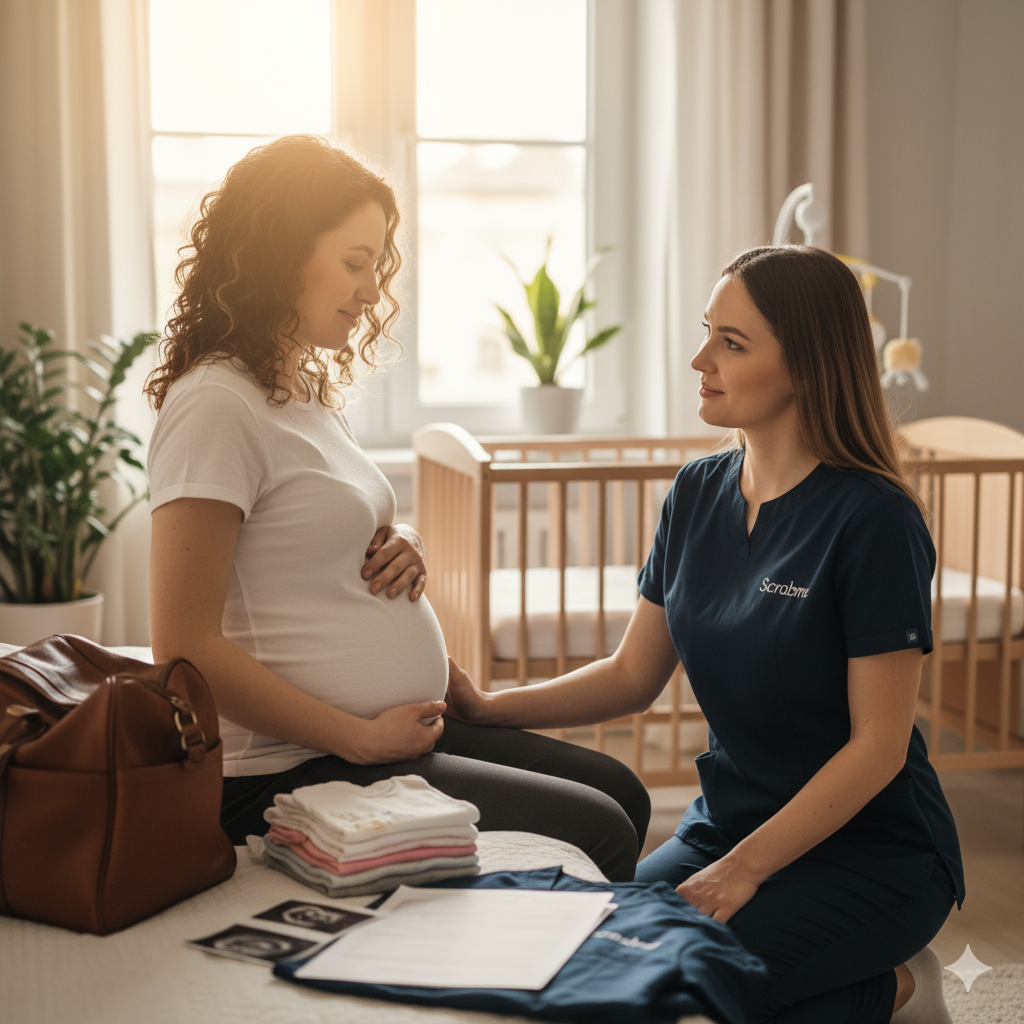
Preparing for childbirth is a time full of excitement, but also natural fears. As midwives, we accompany women on this extraordinary journey on a daily basis. We see what a huge difference conscious preparation makes - not only physically, but above all mentally.
We want you to enter the delivery room confident and calm. Therefore, based on our years of experience, we have compiled a list of 7 key steps to help you tame your fears and focus on what matters most.
1. Birth Plan: Your Road Map (But Be Ready for a Change of Route)
A birth plan is a document in which you write down your expectations and preferences for the birth of your baby.
- What is worth including? Think about your preferred methods of pain relief (pharmacological and non-pharmacological), vertical positions, the presence of a companion or the first moments with the baby (skin-to-skin contact).
- Why is this important? It allows you to consciously analyse the options available to you. For us, the medical staff, it provides valuable guidance on how best to support you.
- Remember: Childbirth can be dynamic. Treat the plan as a signpost, not a rigid scenario. The most important thing is your safety and the safety of your baby.
2 Wise Birth School: Knowledge is Power
If you have the opportunity, enrol in a birthing school - preferably one recommended by other mums or your doctor. It's not about learning a „textbook” birth, but about:
- Understanding the physiology of childbirth (when to go to hospital, what the different phases look like).
- Learning breathing and relaxation techniques.
- Getting to know the hospital space and getting to know the staff.
Knowledge realistically reduces anxiety. A woman who understands what is happening to her body is much more cooperative and less likely to panic.
3 - Hospital Bag: Pack Like a Pro
Panic packing during contractions is the last thing you need. Prepare a bag (or preferably two - one for yourself and one for the baby) as early as around the 36th week of pregnancy.
Key midwife advice: Break things down into stages.
- To the Delivery Room: Birth shirt (preferably unbuttoned), mineral water with mouthpiece, energy snacks, lipstick, hair elastic.
- For the postpartum period: 2-3 nightgowns (to facilitate breastfeeding), dressing gown, shower flip-flops, toiletries, towels, postnatal panties and large sleepers.
- For the Child: Several sets of clothes (bodysuits, rompers), a cap, non-scratchers, a horn or blanket, nappies in the smallest size, wet wipes.
Don't forget documents (pregnancy card, identity card, test results).
4. Trust Your Team (And Your Body)
When you get to the delivery room, you will be surrounded by a team of professionals for whom this „big day” is an everyday occurrence. The midwife will be your main guide. Trust in her experience.
We, as staff, are there for you. Our professionalism manifests itself not only in our knowledge, but also in our readiness to act. Comfortable, functional medical scrubs for women, The clothes we work in are not just an outfit - they are part of our preparedness. They allow us to concentrate fully on you and your baby, ensuring freedom of movement at key moments and hygiene at work. By choosing Scrabme, many midwives rely on comfort to help them perform their mission even better.
5. Breathing and Movement Power
Your body instinctively knows how to give birth. Don't fight the contractions - work with them.
- Breathing: In the birthing school you will learn various techniques. The simplest rule of thumb: inhale with your nose, exhale long, calmly with your mouth. This oxygenates you and the baby and eases the pain.
- Movement: If there are no contraindications, be active. Walk, swing on a ball, change positions. Gravity is your ally.
6. Prepare for Postpartum
Most of the focus is on the birth and we forget about what comes immediately afterwards. Postpartum is a time of convalescence, hormonal storm and learning a new reality.
- Organise help for the first few days after returning home.
- Accept that you may feel tired and sore.
- Don't be afraid to ask for support - whether from your partner, your family, a lactation consultant or a urogynaecological physiotherapist.
7. Plan B: In the Event of an Emperor's Cut
Even if you are setting yourself up for a natural birth (SN), it is worth having a „plan B” in mind. Nearly 40% births in Poland end by caesarean section (CC) - both elective and emergency.
Knowing what this procedure is like and the recovery afterwards gives great peace of mind. It takes off the pressure of „birth at all costs” and allows you to accept the situation should SN prove impossible or dangerous. Remember, the method of delivery does not define you as a mother.
Preparing for childbirth is a process. Give yourself time, listen to your body and don't be afraid to ask questions. You are stronger than you think!
And if you are a midwife, doctor or work in the medical field and are looking for clothing that combines professionalism with unparalleled comfort - the check out our collection scrubs medical women's Scrabme. We created them thinking about heroines like you.
https://scrabme.com/kategoria-produktu/odziez-medyczna-damska/bluzy-medyczne