

Imagine medicine without transplants. A world where heart, lung or kidney failure was an irrevocable sentence. A world without second chances. Hard to imagine, isn't it? Transplantology, the branch of medicine that deals with organ transplantation, is probably the greatest miracle that science has given to mankind in the 20th century.
This is not a story about one operation. It is a story about titanic work, the courage to cross boundaries, painful failures and breakthroughs that forever changed the definition of what is possible. The Polish history of transplantation is full of such moments - moments when the determination, genius and courage of individuals pushed the whole system forward.
As a brand whose mission is to support medical professionals, we feel obliged to pay tribute to the pioneers. This is the story of how Poles gave the world and each other a second life.
Before the Breakthrough: The World Waits for a Miracle
Before Polish doctors could make a breakthrough, the world had to „learn” transplantation. For decades, the biggest barrier was not the surgical technique (suturing the vessels), but the discard. The recipient organism treated the new organ as an enemy.
The mastery of immunology and immunosuppressive drugs was crucial. The world's first successful kidney transplant (between monozygotic twins, which eliminated the problem of rejection) took place in Boston in 1954. The first successful lung transplant in 1963 and a liver transplant in 1967. The world was ready. Poland too.
Cornerstone: First Successful Kidney Transplant (1966)
It all started in Warsaw. Although the first unsuccessful attempts at transplanting a kidney from a cadaver took place at various centres, the official beginning of Polish transplantology is considered to be the date of 26 January 1966.
It was then, at the First Surgical Clinic of the Medical Academy in Warsaw, that a team led by the Prof. Jan Nielubowicz i Prof. Bolesław Albin performed the first successful transplant of a kidney in Poland, taken from a deceased person. The recipient was an 18-year-old girl, Danusia.
This was an absolute breakthrough. Nielubowicz and Albin not only performed the operation, but implemented the entire system - from diagnosis, to immunosuppressive treatment, to managing the patient after the operation. They proved that in Poland, despite political difficulties and equipment shortages, world-class miracles can be performed. The Lindley Street clinic has become the cradle of Polish transplantology.
Heart of the Nation: Professor Religa and the Night That Changed Everything (1985)
Over the following years, Polish kidney transplantation developed rapidly. But one organ remained taboo, both medically and ethically - the heart.
In the world, the first heart transplant was performed by Christiaan Barnard in 1967. In Poland, attempts were made as early as 1968 (Prof. Jan Moll, Prof. Antoni Dziatkowiak), unfortunately without success. The subject fell silent for years. What was needed was someone with notzłomuch determination to pick up the gauntlet.
That person was Prof. Zbigniew Religa.
In 1985, at the newly established Regional Cardiology Centre in Zabrze, Religa assembled a team of young, ambitious doctors and set himself a goal - a successful heart transplant.
A night with 5 on 6 November 1985 przeszła to history. After hours of gruelling surgery, the new heart took up work in the body of 62-year-old farmer Joseph Krawczyk. The patient survived for two months. While this may seem like a short time today, at the time it was a gigantic success. Religa proved that it was possible.
The real success came a year later. But it was this first operation that became the stuff of legend. It was immortalised by a famous photograph taken for „National Geographic” by James Stanfield. The photograph, in which a tired Religa sits at the apparatus, while his exhausted assistant (Dr Romuald Cichoń) sleeps in the corner of the room, made the rounds of the world. It became a symbol of the determination and revolution that had taken place in Polish medicine.
Evolution of the Hero: From Apron to Professional Scrubs
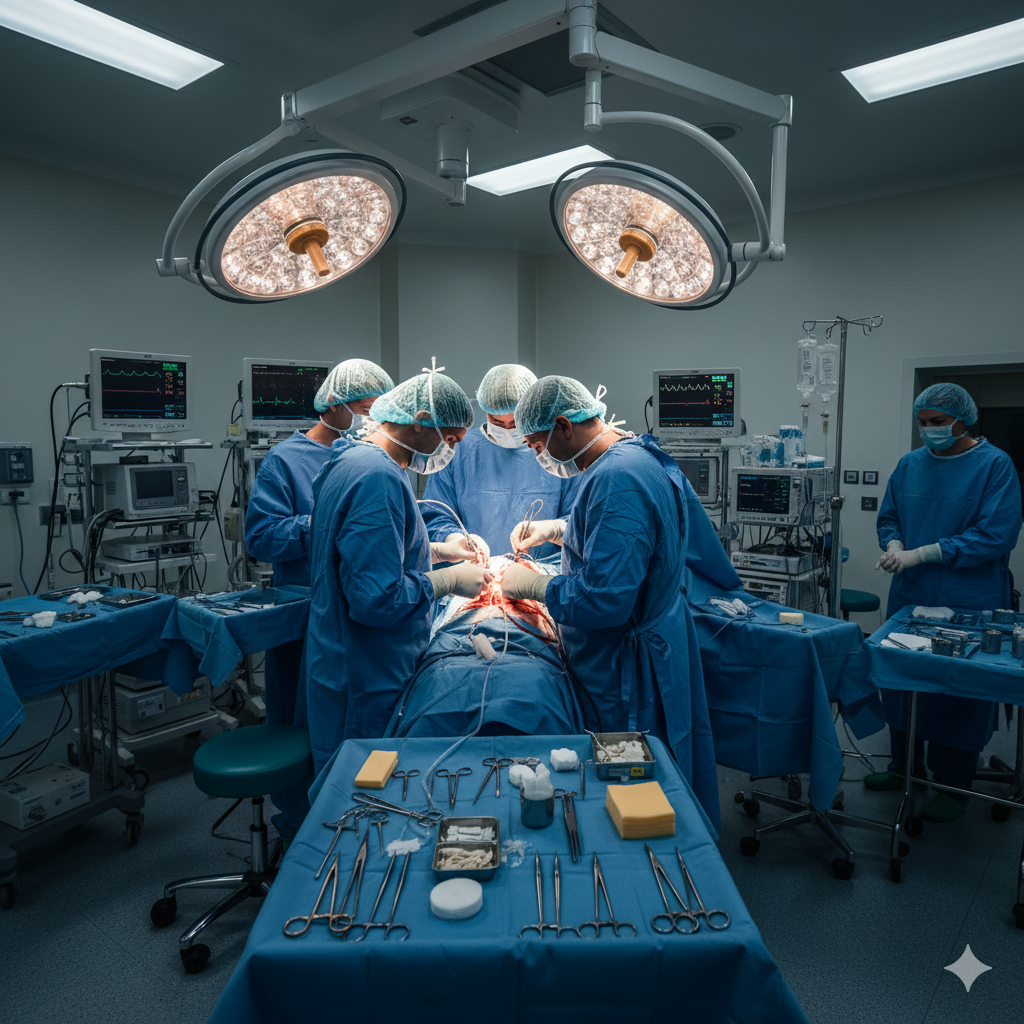
This famous photo from the Zabrze operating theatre shows something else - the evolution of the surgeon's image. Gone are the times when one entered the room almost in white, stiff aprons. Religa's team, bent over the patient, is dressed in functional green operating suits.
This was a key moment in the perception of professionalism.
Why Green and Blue?
The transition from white to colour was fundamental. White, in the harsh light of the operating lamps, was blinding, caused visual fatigue and intensified the after-image effect (when the surgeon shifted his gaze from the bloody operating field to his colleague's white gown, he saw green spots). The colours green and blue are opposite to red, neutralising this effect and allowing the eyes to rest.
The Birth of Modern Scrubs
Those 1980s outfits were the forerunners of what we know today as modern scrubs. This evolution was dictated by the pure functionality that transplantation - one of the longest and most demanding procedures - requires.
A heart or liver transplant operation takes 8, 10, 12 hours. The surgeon and the entire team have to stand in full concentration during this time.
- Comfort and Ergonomics: Contemporary medical scrubs is no longer just cotton. These are high-tech fabric blends that are flexible. They must allow full freedom of movement of the shoulders and back.
- Temperature Management: The material must be „breathable”, wicking away moisture and sweat so that the surgeon does not overheat under the stress and heat of the lamps.
- Functionality: Finally, scrubs have become a working tool. Every element, from the pen pocket to the reinforced seams, is designed with durability and practicality in mind.
Today, when we look at transplant teams, we see professionals dressed in perfectly fitted medical scrubs for women and masculine. It is a uniform that symbolises the highest degree of hygiene, focus and preparedness. It is an evolution that began precisely with operations such as that of Religa.
The Law on the Side of Life: The 1995 Act and the Definition of Brain Death
The biggest obstacle to the development of transplantology in Poland, even after Religa's success, was not technology, but law and ethics. There was a lack of a clear legal definition of death and rules for organ harvesting.
The breakthrough came in 1995, when the Sejm passed the Act on the Collection and Transplantation of Cells, Tissues and Organs. This was a milestone. It was crucial to introduce definition of brainstem death. It has been established that this irreversible cessation of brain function is tantamount to the death of the czł person, even if the heart (supported by apparatus) is still beating.
Equally importantly, the law introduced the principle of „implied consent”. This means that if the deceased did not object during their lifetime (e.g. by registering in the Central Register of Objections), they are presumed to have consented to organ donation. This law, one of the most modern in the world, has opened the door to the rapid development of transplantology.
Blow and Recovery: Crisis of Confidence (2007)
Polish transplantology was going from strength to strength until 2007. Then there was a sharp crisis of public confidence. The high-profile media case of the arrest of a cardiac surgeon and unfortunate statements by politicians (including the then Minister of Justice) undermined a fundamental principle - the integrity of brain death adjudication.
The effect was catastrophic. People stopped consenting to donations en masse. The number of transplants fell by nearly 40% in a year. It was a dark time that showed how fragile the system was, based entirely on public trust. It took years of hard educational work by the entire medical community to rebuild that trust.
A New Chapter: Rebuilding Trust and Breakthroughs for the 21st Century
Fortunately, Polish transplantology has risen from its knees. Thanks to programmes such as the „National Programme for the Development of Transplantation Medicine” and the tireless work of coordinators, Poland is back on the path of development.
The achievements of recent years have been absolutely world-leading:
- Development of Lung Transplantation: The centre in Zabrze has become a leader in this extremely difficult field.
- Chain Grafts: The introduction of complex kidney transplants between pairs who are not compatible with each other (known as cross-transplantation), which has dramatically increased the number of available organs.
- Face Transplant (2013): An absolute breakthrough on a global scale. The team, led by Prof. Adam Maciejewski in Gliwice performed the world's first urgent face transplant to save a patient's life.
Summary: Gift, Team and Professionalism
The history of Polish transplantology is a sine wave - from euphoria to deep crisis. What remains constant is that three pillars are at its core:
- Gift: An anonymous, altruistic decision by the donor and his or her family.
- Law: A wise legal system based on implied consent.
- Team: Hundreds of people - surgeons, anaesthetists, transplant coordinators and nurses.
It is they - the silent heroes in their professional scrubs - They fight a daily battle against time. They work in the shadows to give someone light and a second life.
The history of transplantation is the history of giving. The most important part of it could be you. Think about your decision and carry your statement of intent with you - it's a small card that has the power to save lives.
And if you are one of the silent heroes of this story - a doctor, nurse, paramedic or coordinator - we know that your job requires superhuman strength. Check out the collection medical scrubs Scrabme. We created them to keep up with your passion and give you the comfort you deserve.