
You enter the salon. You are greeted by the scent of sandalwood, relaxing music and a professional whose radiant complexion is the best showcase of her services. For an hour you are the centre of attention, your skin is pampered and you relax. You leave with the feeling of a „new face”. However, the real battle for beauty takes place outside the salon walls, in your bathroom, bedroom and kitchen. As cosmetologists, we often see how mistakes in our daily routine nullify the results of our hard work. Sometimes we would like to hand you a manual for your own skin.
This article is just such an instruction manual. It's a collection of 10 honest, uncompromising and tried-and-tested tips you'd hear from your trusted beautician if you had time for a long coffee after your treatment. We'll touch on skincare topics, debunk marketing myths, but we'll also take a look behind the scenes of professionalism - you'll learn why hygiene and what a professional is wearing are more important than the brand of cream they use.
Here are 10 tips that will change your approach to looking after yourself.
1. Hygiene is the Holy Grail (And you can see it by the clothes you wear)
Let's start with a topic that rarely appears in colour magazines, but is the foundation of safety. When you're choosing a salon, you're probably looking at photos of the effects on Instagram. This is important, but as an expert I'll tell you: look at the cleanliness. And it's not just about the floor or autoclaved sterilised tools (which is an absolute legal requirement). It's about the personal hygiene of the person leaning over your face.
Your skin is „open” during a treatment - be it cleansing, mesotherapy or acids. The epidermal barrier is compromised, the pores are dilated. This is a gateway for bacteria. This is why professional cosmetic clothing It is not an invention or a matter of fashion. It is a protective barrier. If your beautician receives you in a private jumper in which she has previously ridden the bus or gone shopping, a red light should go on. We carry dust, dust mites, animal dander and viruses on the fibres of everyday clothes.
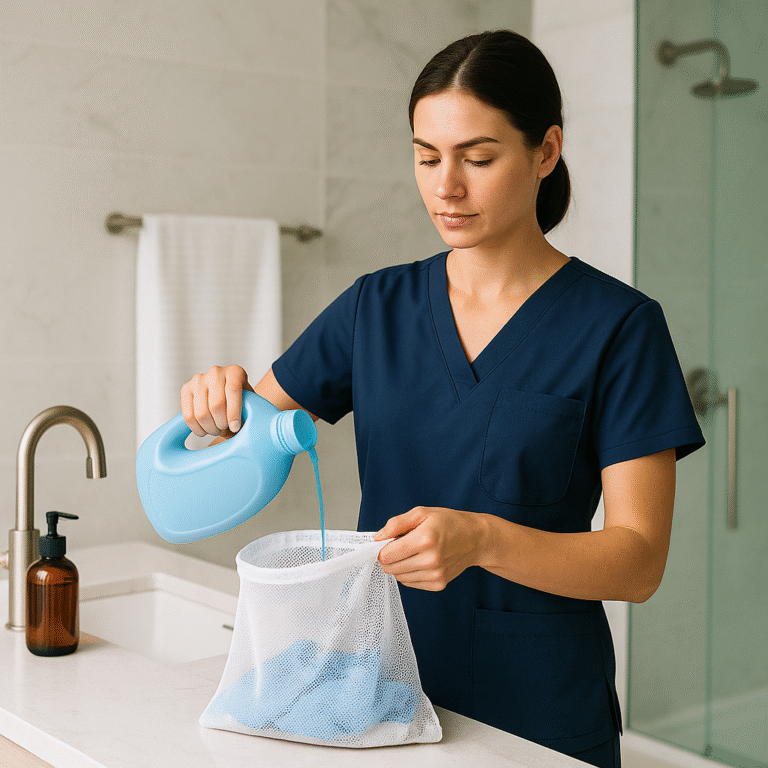
In a professional practice, a dedicated cosmetic uniform. Why? Because it is made of specialised materials that wash at high temperatures, which kill microorganisms. The fabric from which it is sewn cosmetic tunic, It has a smoother texture than cotton, making it harder for dirt to settle on it and preventing any dirt from preparations from penetrating the fibres. A self-respecting cosmetologist changes into his or her working clothes as soon as they arrive at work. This shows respect for your health. Pay attention to it - is the apron clean, ironed and professional? This is the first and most important test of salon quality.
2. the 80/20 rule: the Cabinet is Only the Impulse
Very often clients expect a miracle after one visit. „Ms Anne, I have a wedding in a week, let's do something to make this hyperpigmentation I've been growing for 10 years disappear”. Unfortunately, cosmetology is not magic, it's biology.
You need to understand the 80/20 rule.
- 20% of success are in-office treatments. Here we act powerfully, stimulate the skin, use concentrations you can't buy in a drugstore and technology that costs a fortune. We give the skin a powerful boost of remodelling.
- 80% success story is your daily home care.
Imagine going to the gym once a month and doing a killer workout, but the rest of the days you eat fast food and lie on the sofa. Would you get in shape? No. It's the same with skin. The best laser treatment won't remove wrinkles if you don't moisturise your skin every day and protect it from the sun. Your beautician is your skin's personal trainer - she sets the plan and makes the adjustments, but you have to „exercise” (i.e. wash off make-up and apply cream) yourself every day.
3. SPF Filter is the Best Anti-Wrinkle Cream
If I had to choose one product that I would take to a desert island that would realistically stop time, it would be a sunscreen with SPF 50. Not retinol, not vitamin C, not hyaluronic acid, just sunscreen.
Why? Because UV radiation is responsible for 80% the visible signs of ageing (wrinkles, sagging, discolouration, „spider veins”). The sun destroys collagen in your skin like a microwave. To make matters worse, UVA radiation (responsible for aging - A for Aging) penetrates through clouds and through glass. It has the same effect in November as it does in July.
If you're spending thousands of złots on rejuvenating treatments and you don't apply sunscreen every morning, it's like throwing money into the mud. No treatment will repair your skin as quickly as the sun will damage it. Apply SPF every day, regardless of the weather. It's the cheapest and most effective investment in your youth.
4. Face Ends at the Bust
This is a classic mistake that we see in surgeries every day. The client has a well-groomed, smooth face with no wrinkles, and below the jawline... her true age is showing. The neck and décolleté are the forgotten zones, and they are extremely difficult to revitalise.
The skin on the neck is thinner, has fewer sebaceous glands and loses elasticity more quickly. In addition, we live in the age of smartphones - constantly looking down causes the so-called „Venus rim” or „tech-neck” (tech-neck).
Tip from the beautician: Anything you apply to your face, apply to your neck and décolleté too. Make-up remover? Also on the neck. Toner? Also. Vitamin C serum? Mandatory. Cream with sunscreen? Absolutely yes. Stretch your skincare down. When we cosmetologists perform a treatment, our cosmetic tunic allows us to work freely at the chair so that we can accurately work out these zones with a massage or appliance. You at home don't forget about them either.
5. paper towel instead of cotton towel
Do you have acne, blackheads, inflammation that refuses to heal despite using expensive cleansing gels? Take a look at your towel.
A terry towel hanging in a damp, warm bathroom is a luxury hotel for bacteria and fungi. By wiping your face with it, you rub germs that have multiplied since yesterday into your clean skin every day. What's more, laundry detergent residues can irritate sensitive skin.
Change the habit. Only use disposable paper towels or tissues to dry your face. Place them gently on your skin to soak up the water (don't rub!). This one simple change can reduce imperfections by half in a month. It's a rule of thumb we follow in the offices - sterility first and foremost.
6. Don't be an Amateur Chemist
The internet is full of advice. „Apply glycolic acid, then retinol, then vitamin C in the morning”. TikTokers show a 10-step skincare routine. The result? We get clients with burnt, red, flaky skin and a damaged hydrolipid barrier.
In skincare, „more” does not mean „better”. The skin has its limits. Combining powerful active ingredients on their own often ends in disaster. If you're using retinol, ditch the acids. If you do peels, ensure strong regeneration (ceramides, lipids).
Trust a specialist. A good cosmetologist will prescribe a „Beauty Plan” for you. Sometimes he or she will recommend stopping everything and washing your face with a gentle emulsion for a month so that your skin regains its balance. Don't experiment on a living organism. Your face is not a laboratory.
7. Squeezing is a Crime (Leave it to Us)
We all do it. You see a pimple in the mirror and your hands wander to your face of their own accord. „Just this once.” Stop.
Why does the cosmetologist so strongly prohibit self-squeezing?
- Lack of sterility: Your nails are not sterile. You are injecting bacteria deep into the wound.
- Direction of force: By squeezing the lesion with your fingers, you often cause the sebaceous gland capsule to rupture under the skin. The pus spills inside the tissue, leading to a large, painful tumour or cyst that takes weeks to heal.
- Scars and discolouration: You damage the epidermis mechanically. From a small pimple you make a wound that will leave a mark for years.
Manual cleansing in the surgery looks completely different. The skin is plumped, the tools are sterile and the specialist knows at what angle to press to remove the contents without damaging the tissue. We do it with gloves, magnifying loupes and clean clothes. Our cosmetic clothing is a barrier so that nothing from our clothes falls on your face, and professional lighting allows us to see what you cannot see in the bathroom mirror.
8. the „Sugar Face” and „Dairy Face” diets”
You are what you eat - your skin too. We often treat acne in adult women who have great skincare but a terrible diet.
- Sugar: Causes the glycation process. The sugar combines with collagen fibres, making them stiff and brittle. The result? Faster ageing, flabby skin and a so-called „sugar face” (grey, tired). In addition, insulin spikes fuel sebum secretion and acne.
- Dairy: In many people, cow's milk increases inflammation. It contains hormones (natural to the cow, but not to the człowie) and growth factors that can stimulate acne, especially in the chin and jaw area.
Watch your body. Sometimes quitting chocolate and lattes on cow's milk works better than the most expensive antibiotic. Also remember to drink water. Dehydrated skin is grey and wrinkles are more visible on the skin. Drink a minimum of 2 litres of water a day - it's a natural „filler” for wrinkles.
9th Pillow - Enemy or Friend?
You spend about 7-8 hours a day with your face pressed against a pillow. That's 1/3 of your life!
- Material: Cotton is absorbent. It drinks expensive night cream out of your face and, in the process, „rots” your skin, causing what are known as sleep wrinkles. These are vertical and often asymmetrical (depending on which side you sleep on). Invest in a silk pillowcase. Silk is smooth, doesn't rub your skin and doesn't absorb moisture, so the cream stays on your face and your hair doesn't break.
- Cleanliness: Change your pillowcase at least once a week, and every 2-3 days if you have acne. It harbours mites, sweat and dead skin.
10. Choosing a Specialist is an Investment in Yourself
The last tip is about your consumer decisions. How do you know you've come into good hands?
A good beautician is one who is not afraid to refuse a treatment if she sees contraindications. It is one who takes a detailed health history before touching your face. And finally - it's one who takes care of every detail of her and the practice's image.
As you enter the living room, pay attention to consistency. Is the music relaxing? Is it clean? Does the staff look like a team of experts? Professional cosmetic uniform is more than a garment. It is a message: „I take my work seriously. I am here for you, I am prepared, I am professional”.
Note that in the best clinics you will rarely see a cosmetologist in a casual T-shirt. It's usually a smart, well-tailored cosmetic tunic or a modern medical suite. Such attire provides comfort for the professional (who often works physically for many hours), but above all it creates an atmosphere of trust and safety for you. If someone takes care of their appearance at work, they will take the same care of your skin. Don't be afraid to ask about qualifications, about sterilisation of tools and about the plan for your skin. It is your right and your health.
Remember, beautiful skin is a marathon, not a sprint. It requires patience, consistency and a partnership between you and your cosmetologist. Put these 10 principles into practice and I guarantee that in six months you won't recognise yourself in the mirror - in the most positive sense. See you at the practice!