
Have you ever come home after an on-call meeting with the feeling that the biggest source of fatigue was not the work itself, but the clothes that were supposed to make it easier?
In a medical environment, every movement matters. Leaning over a patient, responding quickly, standing for hours, constantly moving between rooms - in this rhythm of medical tunic ceases to be a mere item of uniform. It becomes a working tool.
A well-designed women's medical tunic can make a real difference to comfort, concentration and a sense of professionalism. The wrong one - distracting, pressurising, restricting movement and tiring.
In this article, we look at why quality matters and how to choose a medical tunic that really works with you.
Why is a medical tunic more than a blouse?
Until a dozen years ago medical clothing was treated purely functionally - it had to be white, conform to the regulations and be easy to wash. Aesthetics, fit or ergonomics were in the background.
Today, the situation is very different.
A modern medical tunic must:
- endure long, often 10-12 hour shifts,
- not restrict movement,
- keep their shape after repeated washing,
- look professional all day long.
This is why more and more women are consciously choosing not casual clothing, but refined medical uniform - often in the form of a set: tunic + trousers or medical scrubs.
Comfort is not a luxury - it is a prerequisite for effective work
In the medical profession, the body is constantly working. Even if you are performing precise procedures in a sitting position, your shoulders, spine and hips remain under tension.
A poorly tailored medical tunic can:
- pull up when bending down,
- pressure in the shoulders,
- cause abrasions under the armpits,
- overheat the body at high temperatures in the surgery.
In contrast, a well-designed women's medical tunic „disappears” as you wear it. You don't think about it. You don't correct it every now and then. You can focus on the patient.
It's a huge difference that you can't see at first glance - but which you feel after a few hours' work.
Material is key
The most common mistake? Choosing solely on the basis of price.
A cheap medical tunic is often made of a material that:
- creases quickly,
- electrifying,
- overheats the skin,
- loses its colour after several washes.
Modern medical tunics are created from clever fabric blends:
✔ Cotton with polyester
It provides a balance between breathability and durability.
✔ Addition of elastane
As little as 3-5% of elastane makes the fabric work together with the body. This is especially important for dynamic movements.
✔ Technical fabrics
Increasingly, materials are being used that are more crease-resistant and quick-drying - reducing care time.
High-quality medical garments are certified for fabric safety (e.g. OEKO-TEX), which is important for hours of skin contact.
Cut - or how the medical tunic affects the silhouette
The cut is something you don't see in the technical performance table.
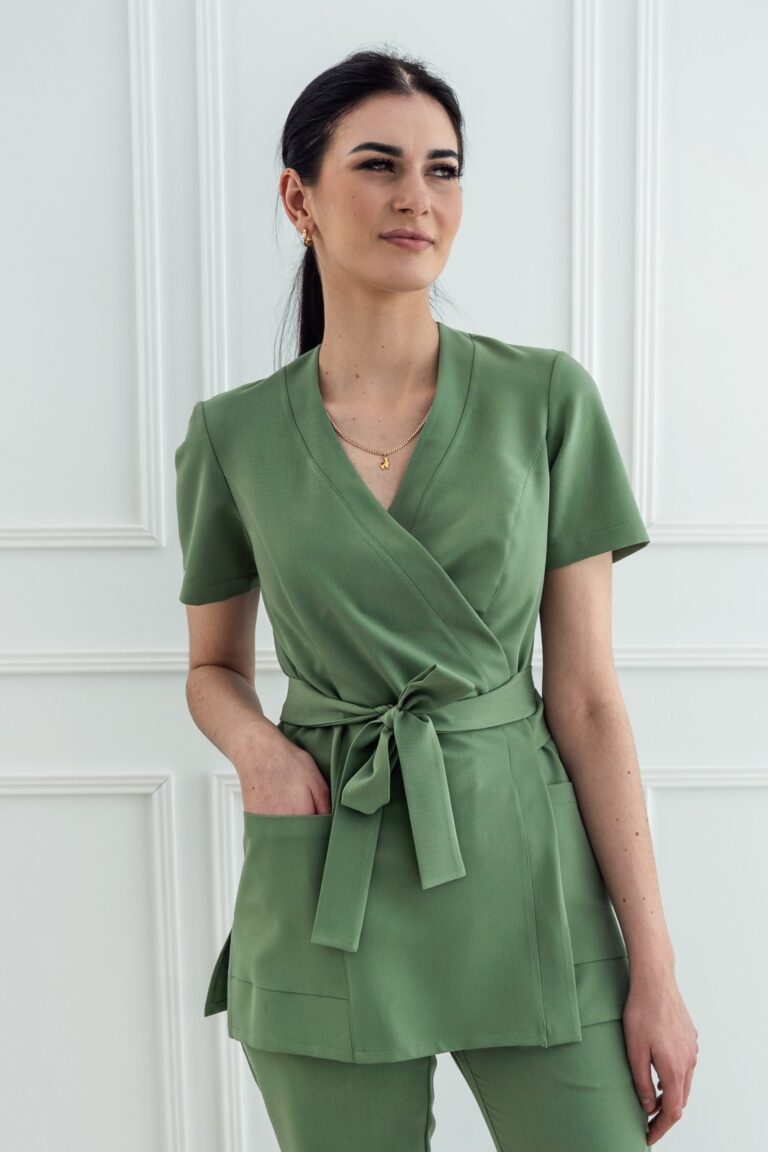
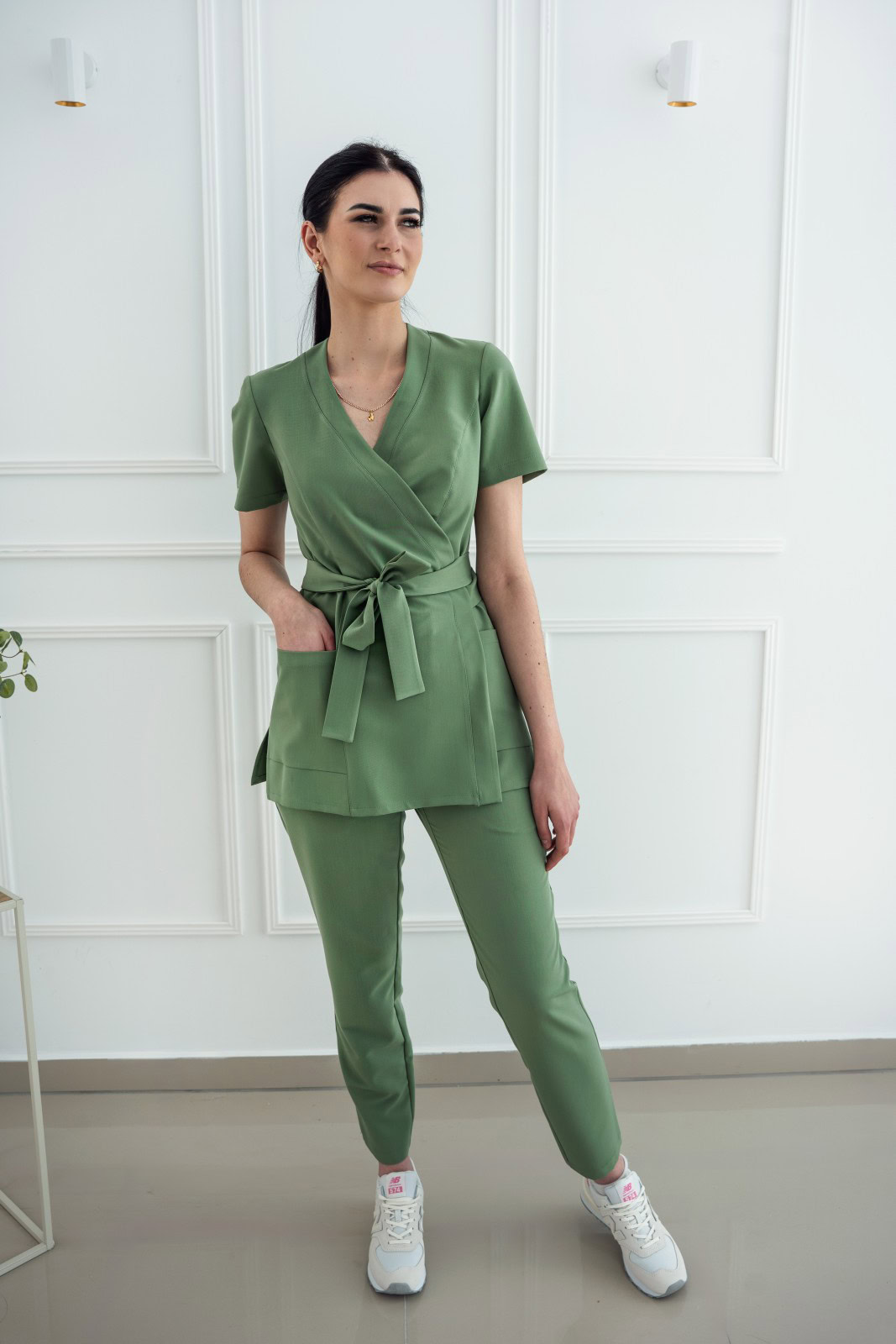
Well-designed women's medical tunic:
- Emphasises the waist, but does not wrap around it,
- ensures adequate length when tilting,
- has side slits for increased freedom of movement,
- has practical but aesthetically pleasing pockets.
Medical tunics versus medical scrubs - differences
Often these terms are used interchangeably, but it is worth distinguishing between them.
- Medical tunic - more fitted, often waisted, elegant.
- Medical scrubs - Looser, sporty, designed for maximum mobility.
The choice depends on the working environment. In private clinics or aesthetic practices medical tunic can be more desirable. In hospital work, medical scrubs provide more freedom.
Ergonomics in practice
Details matter.
A modern medical tunic should have:
- reinforced seams in critical areas,
- pockets adapted to real needs (phone, scissors, pen),
- the right weight of material - neither too thin nor too heavy,
- neckline that provides ventilation but retains a professional feel.
It's the little things that make a huge difference on a day-to-day basis.
Hygiene and sustainability
Medical clothing must be resistant to:
- frequent washing at high temperatures,
- disinfectants,
- intensive use.
A good medical tunic preserves:
- shape,
- colour,
- material structure,
- flexibility.
Cheap equivalents often lose their shape, become mossy or stretch after a few months.
Image psychology
In medical work, first impressions matter.
The patient evaluates:
- cleanliness,
- neatness,
- professionalism.
Fitted, aesthetically pleasing medical tunic builds trust. It is part of non-verbal communication. The image of a professional starts with the details.
The colour scheme also matters:
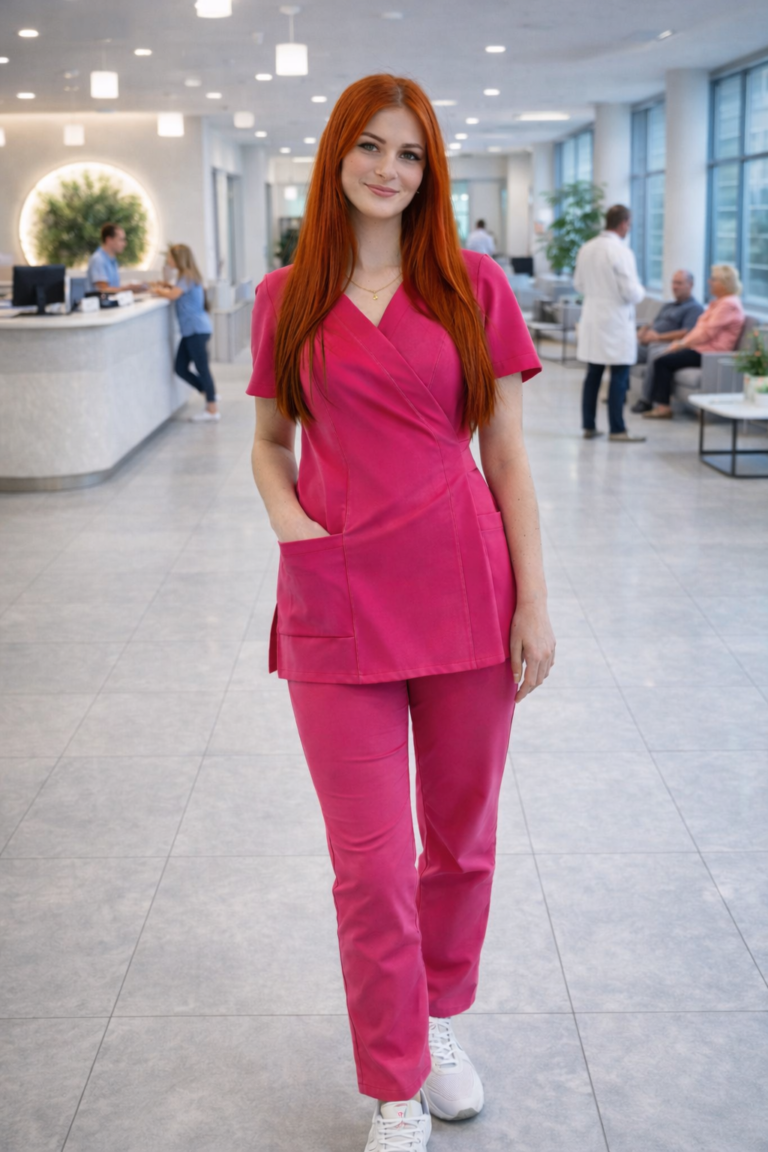
- pomegranate - authority and stability,
- greenery - tranquillity,
- powder pink - empathy and femininity,
- black - modernity and prestige.
How do you choose the perfect medical tunic?
- Pay attention to the composition of the material.
- Check the grammage and elasticity.
- Choose a cut that fits your figure.
- Assess the functionality of the pockets.
- Try it on - movement is the best test.
If you feel pressure in your shoulders during the fitting - it will be worse after 8 hours.
Ecology and informed choice
An increasing number of medical garment manufacturers are introducing lines made from partly recycled fabrics or organic cotton.
This is an important direction - especially in the medical industry, which generates a lot of waste.
An informed medical uniform is not only a comfort, but also a responsibility.
Summary
The medical tunic is not a detail. It's a daily working element that makes a real difference:
- physical comfort,
- concentration,
- wellbeing,
- professional image.
By choosing a quality women's medical tunic or set in the form of medical scrubs, you are investing not in clothes, but in your health and efficiency.
The best medical garments are the ones you stop thinking about while on duty.
Because when the outfit stops getting in the way - you can fully concentrate on what's really important