
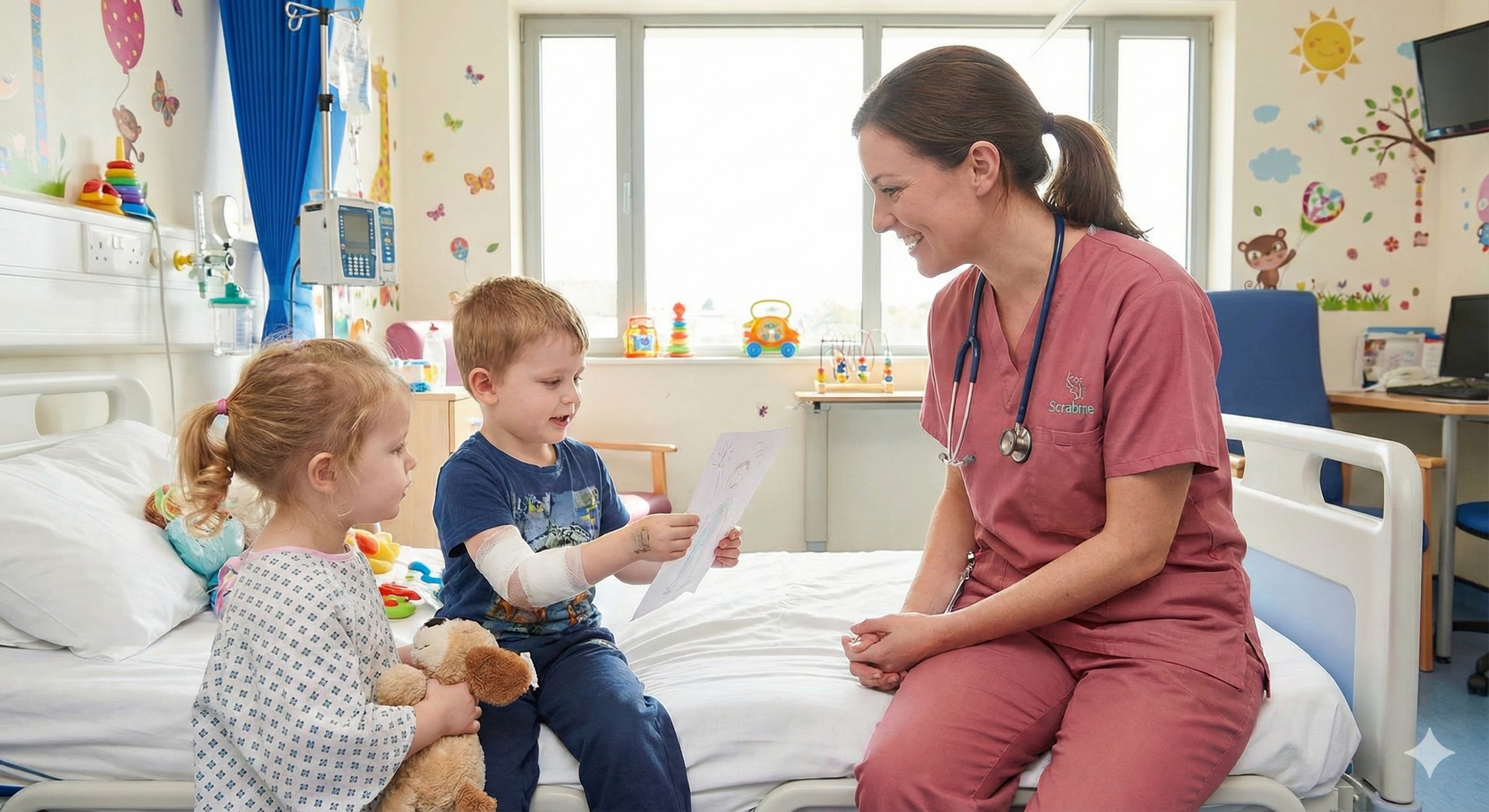
The corridor of the clinic. The smell of disinfectants. The bright, fluorescent light. And that sound - the baby's crying coming from behind the closed surgery door. For many parents, a visit to the paediatrician is a stressful experience comparable to a school-leaving examination. For the child, it is often a trauma that remains in the memory for years, developing into a fear of doctors (iatrophobia) in adulthood.
But does it have to be this way? Must paediatric medicine be associated with forceful holding at vaccination and a cold stethoscope applied to a warmed chest?
Absolutely not.
Modern paediatrics is undergoing a revolution. It is no longer just the science of children's diseases (from the Greek païs - child, iatrós - doctor). It is the art of diplomacy, psychology and empathetic communication, in which the patient - although small and often not yet speaking - is a full partner. It is a field where sterility must meet warmth and professionalism meet playfulness.
In this monumental study, we will take you on a journey through the world of „Paediatrics without Tears”. We will analyse what goes on in the mind of a child entering the surgery. We will debunk the myth of the „white coat” and show you why the colourful medical tunic can do more than a sedative syrup. You'll learn how to prepare your child for the visit and how the medic - through his or her attire and body language - becomes a super hero for the toddler, rather than an oppressor.
Chapter 1: Understanding the „Enemy” - Developmental Psychology in the Cabinetroom
In order to treat a child effectively and, more importantly, to examine them without struggle, we need to understand how they perceive the world. A child is not a „little adult”. His or her brain operates on completely different wavelengths and the perception of danger changes with age.
1st Infant (0-12 months): Safety is Smell and Touch
For an infant, the doctor is an abstraction. It is not afraid of the „examination”. It is afraid of separation from mother, cold and sudden movements.
- A child's perspective: „I am only safe in my mum's arms”.
- Challenge: Physical examination requires undressing the child. A sudden change in temperature and unfamiliar touch trigger a crying reflex.
- Key to success: An examination on the parent's lap, warmed hands and a stethoscope, as well as a doctor's soft clothing. A rough, starchy apron scratching an infant's delicate skin is an immediate wake-up call.
2 The Young Child (1-3 years): The Era of Rebellion and Fear of the Unknown
This is the most difficult age group. The child is beginning to understand that „this gentleman/madam can do me wrong” (e.g. vaccination), but does not understand why. Magical thinking and strong separation anxiety predominate.
- A child's perspective: „If I close my eyes, he disappears,” she says. „It's my body, don't touch it!.
- Challenge: Lack of cooperation. Child fights, kicks, screams.
- Key to success: Distraction, quick action and... appearance. At this age, children respond strongly to visual stimuli. Colour matters.
3 Preschooler (3-6 years): Magical Thinking and Asking Questions
A child at this age wants to know „why?”. He builds narratives.
- A child's perspective: „Will it hurt?”, „Will this stick eat my throat?”.
- Challenge: The child's imagination amplifies the fear.
- Key to success: Turning examination into fun. A stethoscope is a phone call to the tummy and an otoscope is a torch to find dwarfs in the ear.
4 The School Child and the Teenager: Shame and Autonomy
This is where a sense of intimacy comes in. The fear of pain gives way to the fear of being judged and exposed.
- Key to success: Respect, asking permission („Can I tuck your shirt up?”), talking directly to the patient rather than „over their head” with the parent.
Chapter 2: The White Coat Syndrome - Why Tradition Must Go?
For decades, the symbol of medicine was the white, stiff, long apron. It was meant to symbolise cleanliness, sterility and the authority of science. In the adult world, this can work (although it often raises the pressure - so-called white coat hypertension). In the world of children - the white apron is a symbol of danger.
Conditionality mechanism
The child learns by association.
- Visit 1: White coat -> Vaccination -> Pain.
- Visit 2: White coat -> Throat swab -> Discomfort.
- Visit 3: The sight of a white coat -> Automatic cortisol and adrenaline rush -> Crying before the doctor even speaks.
Psychological research makes it clear: white in hospital is associated by children with sterility, coldness and pain. It is an „inhuman” colour, devoid of emotion. Moreover, in mass culture (fairy tales, films), mad scientists or negative characters often wear white smocks.
This is why modern paediatrics is saying a resounding „NO” to rigid uniforms from przeszłości. It's time for colour, softness and „workleisure”.
Chapter 3: Medical Apparel as a Therapeutic Tool
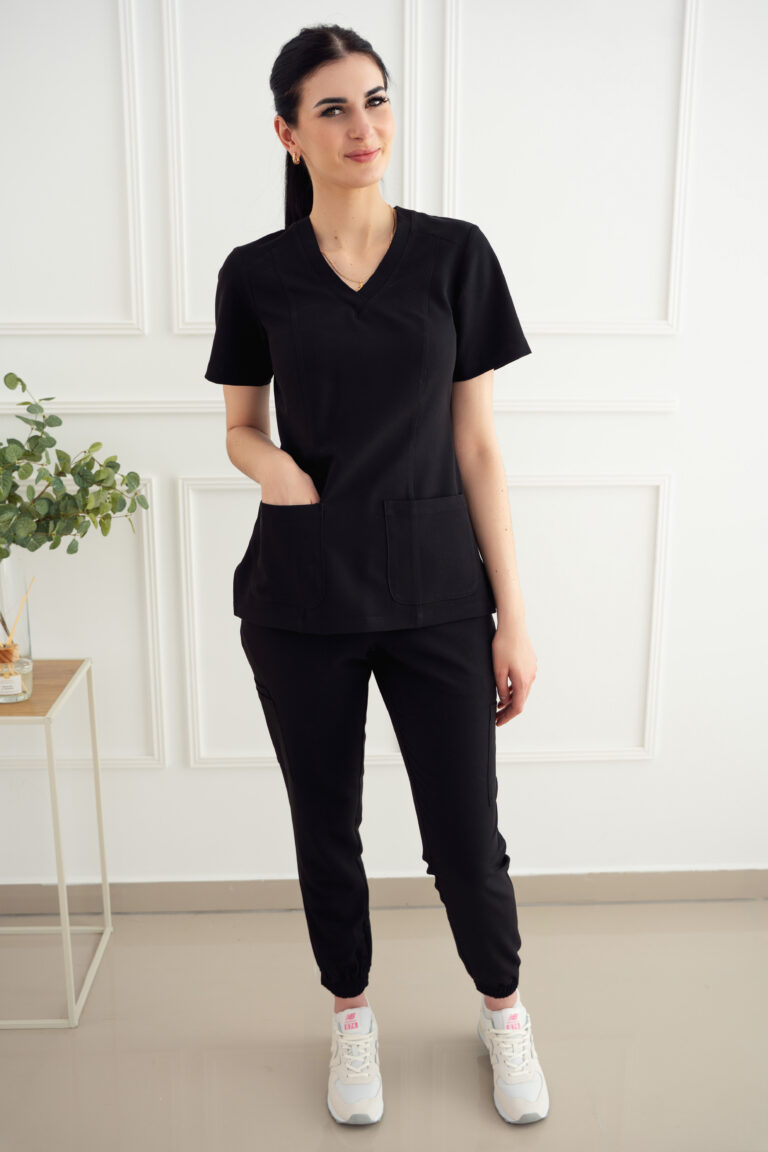
Now that we know that dress matters, let's take a look at how professional medical clothing (scrubs) is becoming a viable tool for the paediatrician, neonatal nurse or paediatric physiotherapist. This is not a matter of fashion. It is part of a medical procedure called „confidence building”.
1. Colour Therapy in the Cabinet - Which Colour to Choose?
The psychology of colour has an immediate effect on a child's subconscious.
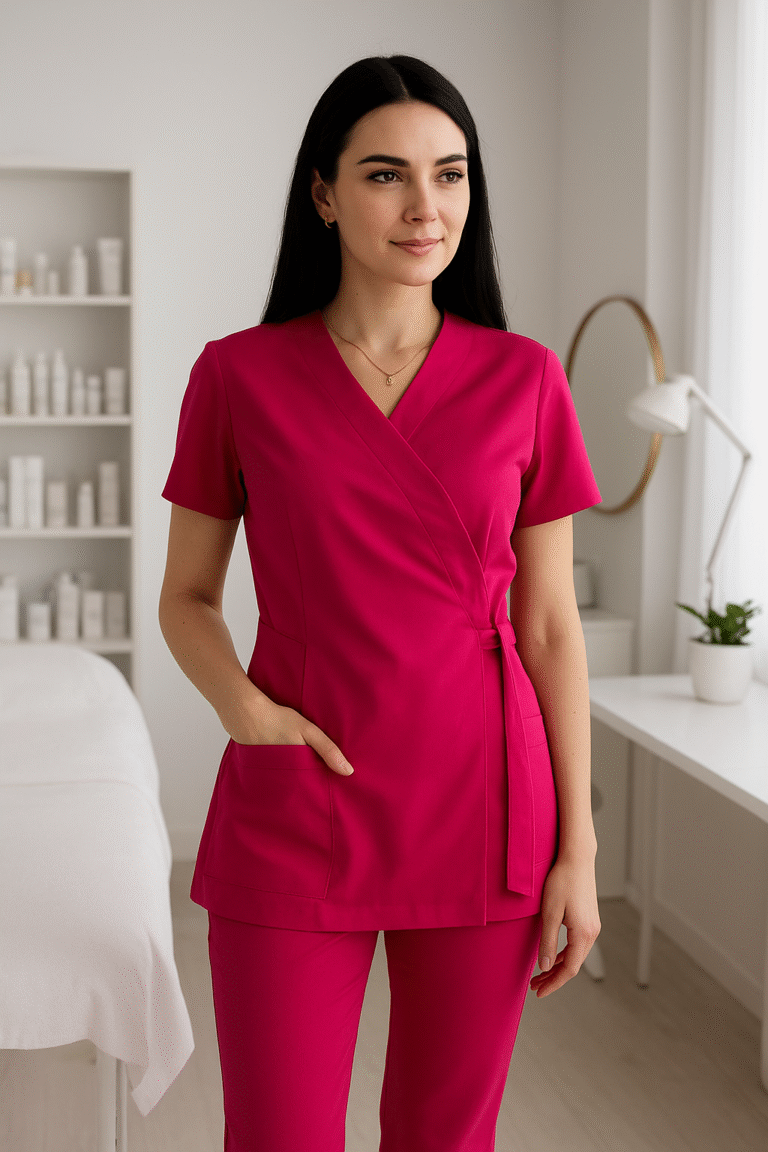
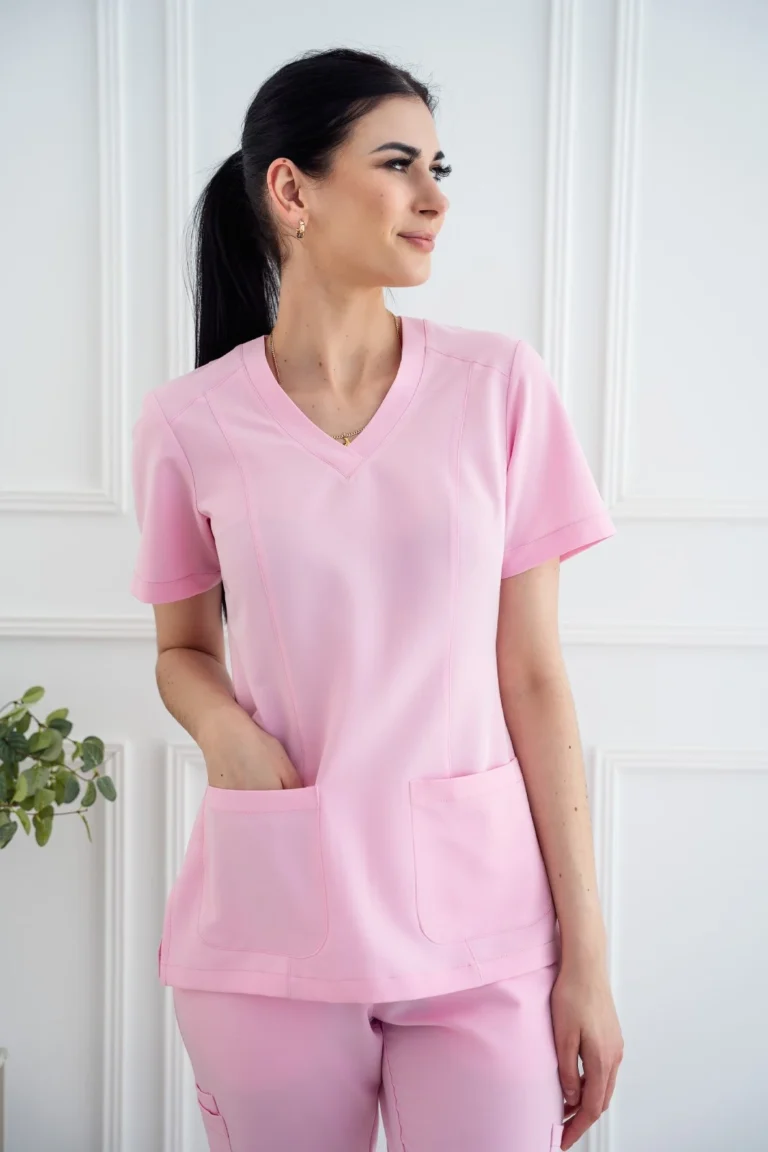
- Pink (e.g. Sweet Pink): The colour of gentleness, warmth and maternal care. Ideal for neonatal wards and nurses' offices. Reduces aggression and anxiety levels.
- Blue and Garnet (e.g. Blue): The colours of peace, stability, trust. They are associated with the sky and water. They are not aggressive. Great for paediatricians working with older children.
- Beiges and Browns (e.g. Latte, Cappuccino): Earth colours. They are neutral, warm and are not associated with the hospital, but with home. They are an excellent choice for child psychologists and speech therapists.
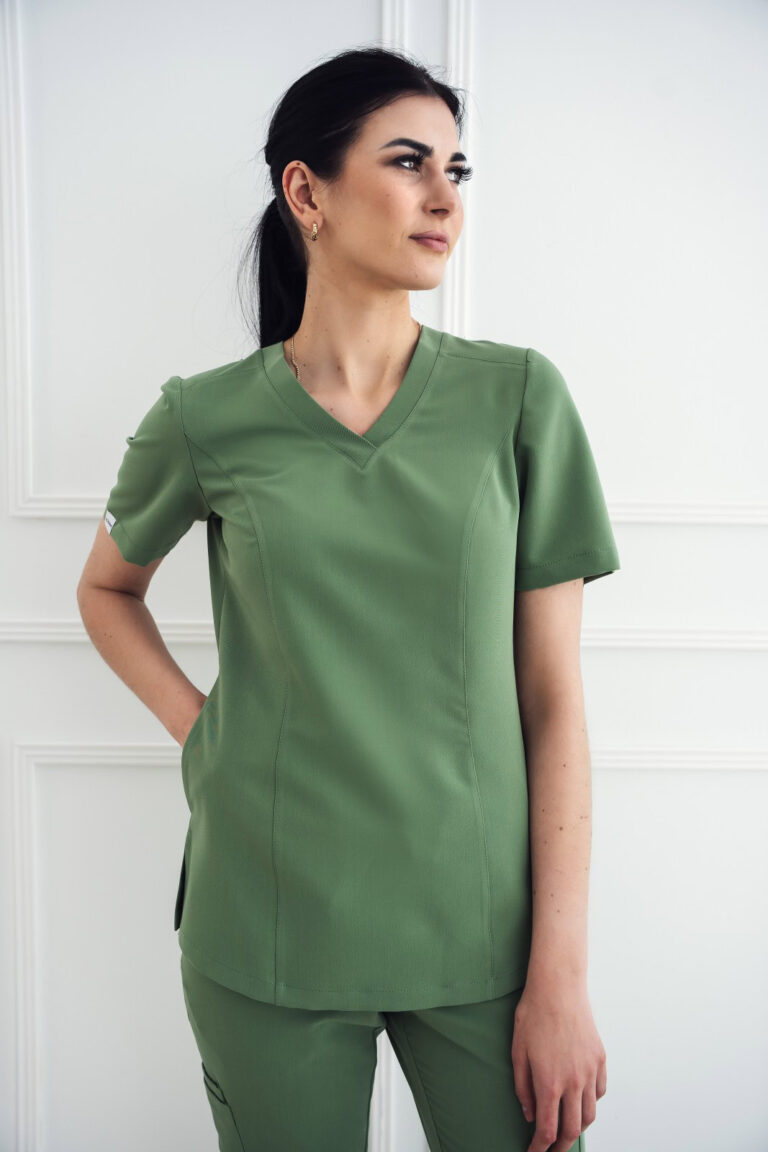
- Green (e.g. Green): The colour of hope, nature and serenity. The least tiring to the eyes.
When the doctor enters in a coloured medical tunic, the child does not immediately pigeonhole him as „that złego from injections”. Curiosity arises: „Oh, the lady is pink!”, „You have a nice sweatshirt”. This second of curiosity is the time the medic gains to make eye contact and smile.
The 2nd Medical Tunic - A barrier that does not divide
When working with a child, physical distance is minimal. Children are hugged, planted on laps, carried in arms. The traditional apron with buttons and collar is stiff, has sharp parts and creates a barrier. Modern medical tunic (scrubs type) is:
- Smooth: There are no buttons that an infant could swallow or scratch against.
- Soft: Made of viscose-blend materials, it is pleasant to the touch. When you hug a crying baby after a vaccination, his cheek touches the soft fabric rather than the stiff polyester. This builds a sense of security.
- Functional: Pockets. They're magical storage compartments. Good medical tunic in paediatrics must have roomy pockets to hide not only the stethoscope, but also „Brave Patient” stickers, stamps or a small toy to divert attention at a crucial moment.
3. Medical trousers (Joggers) - Medical mobility
The examination of a child is rarely done „by the book”, i.e. on the couch. Children are examined:
- On Mum's lap.
- On the carpet (while playing).
- Under the table (when the patient decided to hide).
- On the run (when the patient decided to run away).
Paediatrics is an athletic profession. It requires squatting, kneeling, bending and quick reactions. In this job, stiff cropped trousers or skirts are a mistake. The solution is flexible medical trousers jogger type. The drawstrings at the bottom of the legs ensure safety (you won't step on the leg while chasing your toddler), while the elastic waistband and elastane (Lycra) material allow a full range of movement. The practitioner who is free to sit „Turkish” on the mat next to the child gains giant points in his eyes. He ceases to be a „big doctor” and becomes a playmate who can be allowed to look down his throat.
Chapter 4: Preparation is Half the Success - The Role of the Parent
Even the greatest doctor in the most beautiful, colourful uniform won't work miracles if the parent unwittingly sabotages the visit. The child's anxiety is often a mirror image of the parent's anxiety.
Mistakes we make (often out of love)
- Lying: „It won't hurt. If you go for a vaccination - this is a lie. The child will feel the sting and lose confidence in you and the doctor. It is better to say, ”You will feel a little pinch, like a mosquito, but it will only last a moment and I will be there for you„.
- Scaring: „If you don't brush your teeth, we'll go to the dentist and he'll pull them out for you! Never use the doctor as a bogeyman. The doctor is supposed to be a helper, not a punishment.
- Apologising: „I'm sorry we have to go here”. This suggests to the child that you are doing something złego, hurtful.
- Nervousness: If you are scared, your child is twice as scared.
How do you prepare your child at home?
- Playing doctor: Buy the little doctor's kit. Let the bear be the patient. Set up a „home” medical trousers (e.g. sweatpants) and play with the examination. Let your child auscultate the teddy bear, look down its throat, take an injection. This tames the procedures.
- Educational books: Read stories about visiting the doctor (e.g. „Kitten at the doctor's”).
- Age-appropriate honesty: Say what you are going for. „The doctor is going to check your lungs are healthy so you can run fast.”.
Chapter 5: First Impressions - Entrance to the Cabinet (Zone Zero)
The moment the door opens is crucial. It is those first 30 seconds that determine the course of the entire visit.
Space arrangement
A paediatrician's office must not look like an operating theatre. Colourful walls, a toy corner in the waiting room, interesting pictures on the ceiling (above the couch!) - these are details that distract.
Physician's Body Language
A good paediatrician never stands over a child like a tower.
- Downgrading: The doctor should squat or sit in a low chair so that his or her eyes are at the child's eye level. This nullifies dominance. Here again we return to the role of clothing - comfortable medical trousers allow this position without discomfort.
- Direct return: „Hi Antek! But you have a cool dinosaur on your sweatshirt!”. We greet the child (even a young child) first, then the parent. This builds the child's subjectivity.
- A smile (but without exaggeration): A natural, warm smile. Children are sensitive to falsehood.
Chapter 6: Paediatrician's equipment - Not just a stethoscope
In pockets medical tunics The paediatrician hides a real arsenal. These are not just diagnostic tools, they are „magic artefacts”.
- Heated stethoscope: Applying cold metal to the body is a shock. A good doctor always warms the diaphragm in his hand or about his own clothes before the examination.
- Coloured otoscopes: Animal-shaped ear specula.
- Awards: It is currency in the world of children. The Brave Patient sticker is not a piece of paper. It is a medal. It's proof of bravery to show off in the nursery. It's positive reinforcement („it was hard, but I did it and got a reward”) that pays off at the next visit.
Chapter 7: The Great Game of Investigation - Distraction Techniques
Once the stethoscope is warmed and the first ice is broken, the moment of the actual examination comes. This is where the fate of the visit is weighed. The key is gamification - turning a medical procedure into a fascinating adventure.
Auscultation: Phone call to the tummy
For a child, putting the handset to the chest can be a violation of the intimate zone.
- Technology: „Now we're going to check if there are little tigers burbling in your tummy, or did you eat a frog for breakfast?.
- The role of the medic: The doctor needs to be close. He or she often hugs the head against the baby's back or abdomen. Here, the quality of the material from which the medical tunic, is of colossal importance. The fabric must be soft, hypoallergenic and pleasant to the touch. When a child feels rough polyester, it moves away. Feeling the soft viscose, he relaxes.
Throat Survey: Lion's Roar
The spatula is enemy number one (causes a vomiting reflex).
- Technology: We do not insert the spatula „out of the blue”. We ask the child: „Show me how loud the lion roars! Aaaa!”. With a wide-open mouth and a loud sound, the palate naturally rises and the doctor can often see the throat without touching the tongue with a stick.
- Trick: If a spatula has to be used, we let the child touch it with his hand first, to check that it is not sharp.
Exploring the Ears: Searching for Treasures
Otoscopy can be unpleasant.
- Technology: „We'll shine a torch into your ear and see if there are any dwarves hiding in there or if you can see the other side of your head.”.
- Position: The child sits safely on the parent's lap, facing the doctor sideways. The parent hugs the child, immobilising the arms and head (gently but firmly). The doctor in comfortable medical trousers slides into the chair, adjusting the height so that the examination takes seconds.
Chapter 8: Needle in the Cabinet - Vaccination and Blood Collection without Trauma
This is the moment that everyone dreads - the child, the parent and often the staff themselves (no one likes to cause pain). However, modern medicine knows ways to minimise discomfort.
The „On the Sandwich” method”
We never put the child on the couch and forcibly squeeze it (so-called „pacification”). This breeds trauma and a sense of rape.
- Performance: The child sits on the parent's lap, facing the parent or sideways. The parent is the „slice of bread”, the child the „ham” and the other „slice” is his/her favourite cuddly toy or the parent's hands. The child feels the embrace of love, not violence.
Anaesthetic creams (Magic Glove)
An anaesthetic cream (lidocaine/prilocaine) is worth applying one hour before the blood draw or venipuncture.
- Narrative: „We'll grease your hand with magic cream so you won't feel a thing. Now your skin is asleep.”.
- Effect: The child sees the needle but does not feel the pain of the skin puncture. The cognitive dissonance („I can see and it doesn't hurt”) builds belief in the „magical power” of the staff.
Role of the Treatment Nurse
It is the nurses who perform most of the painful procedures. Their job requires incredible dexterity and speed. The nurse often has to crouch down next to a child, lean out and sometimes even perform acrobatics to hit a vein in a busy patient. That is why medical trousers in the treatment room are a must. They need to be as flexible as sportswear. A nurse struggling with trousers that fall down or a skirt that is too tight loses seconds, which are crucial for an insertion to take place „once and for all”. Staff comfort translates directly into hand precision and less pain for the child.
Buzzy and Virtual Reality
Modern gadgets are allies.
- Buzzy: A small „bee” that vibrates and cools the skin above the insertion site. The child's brain focuses on the cold and vibration, „forgetting” the pain signal from the needle (pain gating theory).
- VR glasses: Older children can be transported into a virtual world while drawing blood.
Chapter 9: Language That Heals - Communication and NLP in Paediatrics
Words have power. They can reassure, but they can also set off a spiral of fear. In paediatrics, we avoid so-called „incendiary words”.
What NOT to say:
- „Don't be afraid.” - The brain ignores the word „no”. The child hears „be afraid”. Also, it is denying the child's feelings.
- „It won't hurt.” - A lie that destroys trust.
- „Be good” - Crying is not rude. It is a natural reaction to stress.
What to say (Positive Language):
- Instead of „pain”: We use the words: „you will feel pressure”, „it will be cold”, „you will feel a tingling”, „a little pinch”.
- Instead of „don't move”: We say: „be still as a statue”, „let's make a wax figure”.
- Validation of emotions: „I can see that you are scared. This is normal. I'm here with you and holding your hand. We'll do it right away and go home.”.
Staff Body Language
Children are masters at reading non-verbal signals. If the doctor is tense, the child will sense it. Loose, relaxed posture, open gestures - this builds calm. Here again, we return to ergonomics. Medical tunic, which does not restrict movement and allows the doctor to gesture naturally. If the clothing is uncomfortable, the doctor makes „stiff”, unnatural movements, which subconsciously alerts the child. A colourful, cheerful print or a pleasant outfit colour is an additional non-verbal message: „I am friendly”.
Chapter 10: The Role of the Parent in the Cabinet - Ally or Obstacle?
The parent in the paediatrician's surgery has a „safe base” role to play. Unfortunately, he or she often becomes an „obstructionist” out of stress. The staff's task is to guide the parent.
Parent Handbook (for Medics)
- Engage: „Please sit Sophie on your lap and hold her hands to her belly”. Give the parent the task, then she will stop panicking.
- Reassure: If a parent shouts at a crying child („stop roaring!”), intervene gently: „Calm down, Sophie has a right to cry, it was unpleasant. She is taking it very bravely”.
- Don't ask out (usually): The presence of a parent is crucial for a sense of security (up to a certain age). Expulsion is used in extreme cases (parent-induced hysteria) or in teenagers (intimacy).
Advice for Parents
Your job is to be a rock. Even if inside you are trembling for your child's health, on the outside you must exude calm. The child looks at your face as if in a mirror. If you smile at the doctor in the pink medical tunic, the child thinks: „Mum likes her, so she is safe”.
Chapter 11: Style Medicine - Why is Image an Investment in Health?
Finally, let us return to the aspect that links psychology with business and professionalism - the image of the medical facility.
The modern paediatric clinic or hospital ward is a brand. Parents, when choosing a doctor for their child, are guided by reviews („does he or she have an approach to children”) and the appearance of the place.
Visual coherence of the Team
Imagine a clinic where all staff wear consistent, aesthetically pleasing medical uniforms.
- Nurses in the colour „Sweet Pink” (associated with care).
- Doctors in „Blue” or „Navy” (authority and calm).
- Registration in „Cappuccino” (hospitality).
Such a view builds a sense of order, cleanliness and the highest standards. It tells the parent: „This is not a casual place. We take care of every detail here”.
Quality you can see and feel
Cheap medical clothing quickly washes, mends and loses its colour. A doctor in a washed, hanging apron loses authority. An investment in medical clothing premium (like Scrabme) is an investment in an expert image. OEKO-TEX-certified materials ensure that when cuddling a small patient with atopic dermatitis, you won't irritate them. Elastic fibres ensure that, after 12 hours on duty, the outfit still looks impeccable and not like pulled-out pyjamas.
For the child, it's all about colour and softness. For the parent - professionalism and hygiene. For the medical professional - comfort and functionality (pockets, breathability). Well-chosen medical tunic and comfortable medical trousers combine all these needs.
Summary: Generation without Trauma
Paediatrics without tears is not a utopia. It is a standard we must strive for. We have the psychological knowledge. We have the tools (anaesthetic creams, thin needles). Finally, we have the awareness of the importance of image and dress that does not frighten but invites relationships.
Every visit that ends with a „high-five” nailed with the doctor and not with crying is a building block for a healthier society. A child who trusts the paediatrician will grow into an adult who is not afraid of preventive examinations.
It all starts with a smile, empathy and... the removal of the stiff white apron in favour of a comfortable, colourful outfit in which the medic becomes a c1TP1Person rather than an institution.
Looking for a paediatrician with a vocation? Pay attention not only to diplomas, but to how the doctor addresses your child and... how he looks. Empathy manifests itself in the details.
Want your little patients to feel safe and your team to work in comfort? It's time to say goodbye to the „white syndrome”. Check out the collection Scrabme medical clothing. Our colourful medical tunics and flexible medical trousers are designed to support you through the toughest challenges of paediatrics - from examining on the carpet to cuddling after vaccination. Build confidence from the first look.