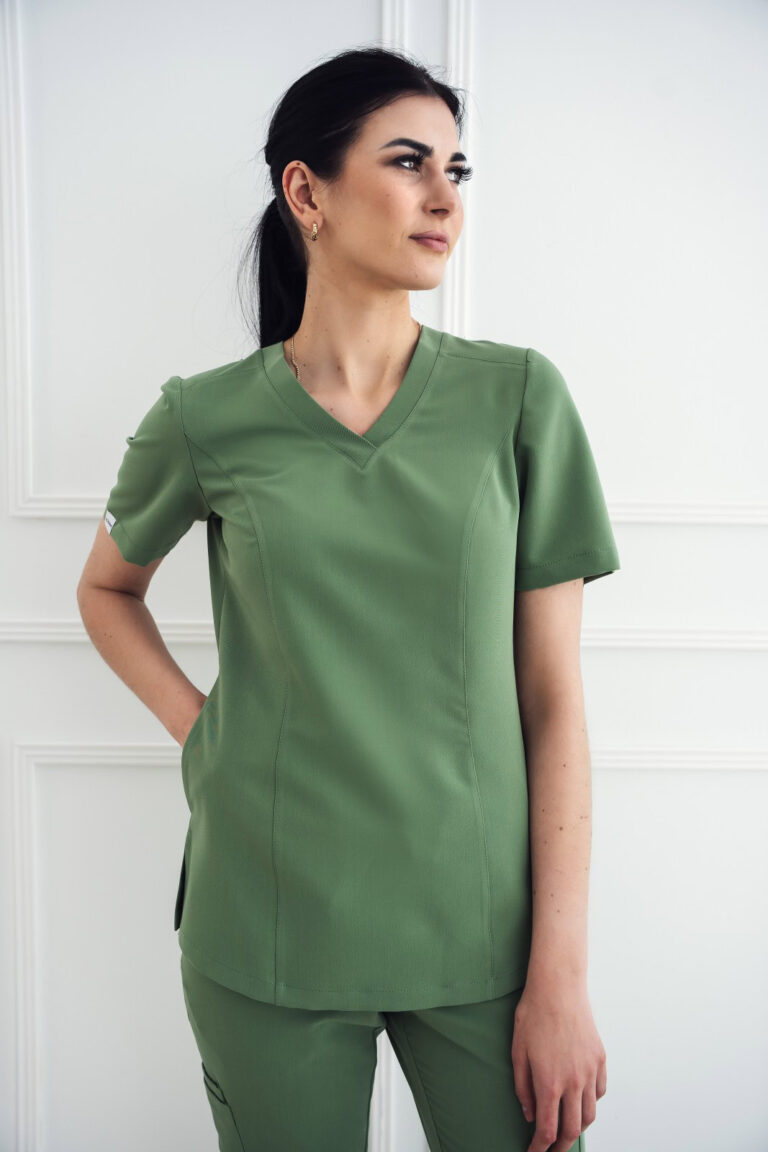


At first glance, all scrubs look alike. The sweatshirt, the trousers, the pockets, the colour. The price often differs by tens or hundreds of złot, but visually the differences seem small. This is why many people working in healthcare opt for cheaper solutions, assuming that a medical uniform is simply a must-have item - something to be clean and in accordance with the rules and regulations of the facility.
The problem is that in medical work, it's what you can't see that matters most. Cheap medical scrubs may look correct in the shop, but after a few weeks of intensive work they start to reveal their weaknesses. And in a profession where concentration, ergonomics and a professional image matter, every detail has an impact on daily functioning.
Medical uniform is not just a garment
To many people outside the industry, it seems that scrubs are simply comfortable work clothes. In reality, a medical uniform is a working tool. You spend 8, 12 and sometimes even 24 hours in it. You perform hundreds of movements - bending down, lifting your arms, moving quickly between wards, bending over a patient.
If material:
- resists,
- does not breathe,
- restricts movement,
- extends unevenly,
then your body has to compensate. And this translates into fatigue, muscle tension and discomfort.
Cheap medical scrubs are most often created to minimise production costs, not ergonomics.
What can't you see in cheap scrubs?
Seam construction
High-quality scrubs have:
- reinforced seams in critical areas,
- staggered joining lines so as not to abrade the skin,
- Appropriate trims at pockets and crotch.
Cheap models often use simplistic designs. The seams start to come apart after a few months, the material becomes mossy and the pockets lose their shape.
The material and its behaviour after washing
In the shop, everything looks good. The real test begins after a few washing cycles at 60°C.
Cheap scrubs:
- lose their colour,
- are shrinking,
- deform,
- are beginning to moss.
Good medical scrubs are designed to:
- withstand frequent washing,
- maintain colour intensity,
- do not require ironing,
- maintain their shape over the years.
It's a difference you won't see on the rack.
Flexibility and 4-way stretch technology
High-quality medical scrubs often contain an admixture of elastane and offer so-called 4-way stretch - the material stretches in four directions.
Cheap scrubs:
- have limited flexibility,
- they only stretch in one direction,
- they deform more quickly.
In practice, this means that with every dynamic movement, the material works against you.
Cheap scrubs and staff health
Ergonomics in medicine is a topic that is still underestimated. Prolonged muscle tension, forced positions and lack of freedom of movement can lead to:
- neck pain,
- back strain,
- shoulder problems,
- leg fatigue.
Medical Uniform, which does not support the body's natural movements, exacerbates these problems.
High-quality scrubs are designed with the following in mind:
- full range of movement,
- appropriate length of sweatshirt,
- elastic waistband in trousers,
- optimum fit for the figure.
It's not a question of aesthetics - it's a question of health.
Professional image vs. quality of scrubs
The patient does not analyse the composition of the material. But he subconsciously perceives visual signals:
- or medical uniform is a good fit,
- whether the colour is intense,
- whether the material looks fresh,
- whether the outfit is not puckered.
Cheap scrubs start to look worn after a few months of use. This can inadvertently affect the perception of professionalism.
High-quality medical uniform builds:
- trust,
- authority,
- impression of order and organisation.
What about the medical tunic?
Some choose the classic medical tunic as an alternative to scrubs. For low-cost models, the problem is similar:
- thin material,
- lack of flexibility,
- deformation after washing,
- loss of cut.
A good medical tunic should be:
- fitted to the silhouette,
- made of breathable material,
- resistant to frequent washing.
However, if it is made of low-quality fabric, its functionality quickly declines.
Economic calculation - does cheap really mean saving money?
At first glance, the price difference seems significant. However, it is worth taking a long-term view.
Cheap scrubs:
- wear out faster,
- require more frequent replacement,
- lose their aesthetic appeal.
As a result, after a year you may end up spending more by buying several cheaper sets than by investing once in a quality medical uniform.
How do you recognise good medical scrubs?
When choosing, it is worth looking at:
- Material composition - presence of elastane and modern blends.
- Quality of stitching and finishing.
- Fitting to the silhouette.
- User reviews.
- Fabric behaviour after washing.
Good scrubs are the ones you forget about as you work because they are comfortable and functional.
Scrubs as part of a modern work culture
Medicine is changing. Staff increasingly expect:
- better working conditions,
- ergonomics,
- aesthetics,
- quality.
The medical uniform ceases to be a mere obligation. It becomes an element of conscious choice.
Cheap scrubs may seem like a sensible solution at first. However, in the long term, it is quality that determines comfort, durability and a professional image.
Bottom line - is it worth saving money on scrubs?
Medical scrubs is more than a piece of clothing. It is a working tool that affects ergonomics, health and the way you are perceived by patients.
Cheap scrubs:
- wear out faster,
- limit comfort,
- lose their aesthetic appeal,
- can exacerbate fatigue.
High quality medical uniform or medical tunic is an investment in:
- convenience,
- sustainability,
- professional image,
- long-term savings.
In a profession where precision and concentration are crucial, attire should support, not hinder. Therefore, the choice of scrubs should not be a decision based solely on price, but on quality and functionality.