
Walking into a modern cosmetic surgery or aesthetic medicine clinic can feel overwhelming. The list of services (the so-called „treatment menu”) often resembles a complicated menu in a molecular restaurant. Names such as „micro-needle radiofrequency”, „tissue biostimulation”, „liposomal peels” or „fractional mesotherapy” sound impressive, but can sometimes be a mystery to the client.
How long does it take? Will it hurt? What will I look like when I leave? Do I need to take a holiday?
Modern cosmetology is no longer just about relaxing with an algae mask. it is advanced science, chemistry and physics that aim to really remodel the skin, reverse the ageing process and treat defects. To make an informed decision, you need knowledge.
This monumental guide has been created to take you through the thicket. Ro1TP1We will break down the most common procedures, look at the preparations used and reveal what really goes on in the practice. We will also highlight the aspect of safety and hygiene, where the professionalism of the staff and their sterile cosmetic clothing.
We begin a journey into the world of conscious care.
Chapter 1: The Foundation for Success - Consultation and Preparation
Before any needle touches the skin or the laser sends out a beam of light, the most important stage must take place: qualification.
Cosmetological Interview (Anamnesis)
It is not a matter of bureaucracy. It is a question of your safety. The specialist needs to know about:
- Chronic diseases (diabetes, thyroid diseases, autoimmunity).
- Medications taken (oral retinoids, antibiotics, blood thinners).
- Lifestyle (smoking, sun exposure, diet).
- Existing home care (which can often be... destructive to the hydrolipid barrier).
Duration: 30-60 minutes. Objective: Rule out contraindications and establish a „Beauty Plan” (long-term strategy).
Preparing the client „Before”
Most advanced treatments require preparation at home. A cosmetologist may recommend:
- Retinol and acid withdrawal 7-14 days before treatment.
- Taking rutin/vitamin C to strengthen blood vessels.
- Drinking min. 2 litres of water a day (hydrated skin responds better to stimuli).
- Antiviral prophylaxis (e.g. Heviran) in people prone to herpes before lip treatments.
Chapter 2: Beauty Chemistry - Acid Therapies (Chemical Peels)
This is one of the oldest and most effective methods of skin renewal. It is not about „peeling the skin”, but about controlled damage that forces regeneration.
1. superficial peelings (AHA/BHA)
They work within the epidermis. Ideal for the „first time”, for acne-prone, dull and dry skins.
- Measures used: Mandelic acid, glycolic acid, salicylic acid, azelaic acid, lactic acid. Often in the form of a gel or aqueous solution.
- Execution time: 30-45 minutes.
- Perceptions: A gentle tingling, warmth.
- Recovery time: Absence or minimal, fine złissue (not visible to the surroundings). It is possible to return to work immediately.
2. medium-depth peels (e.g. TCA, Retinol)
This is where we go deeper. The goal is remodelling, fighting scars and wrinkles.
- Measures used: Trichloroacetic acid (TCA), high concentrations of retinol (so-called Yellow Peel).
- Execution time: 30-45 minutes.
- Perceptions: Intense burning, sensation of heat („frosting” - a convergence of the epidermis).
- Recovery time: 5-7 days. The skin turns brown, tightens like parchment and then intensely cracks and peels in patches. Requires a „holiday from social life”.
The Role of the Specialist: Chemical Safety
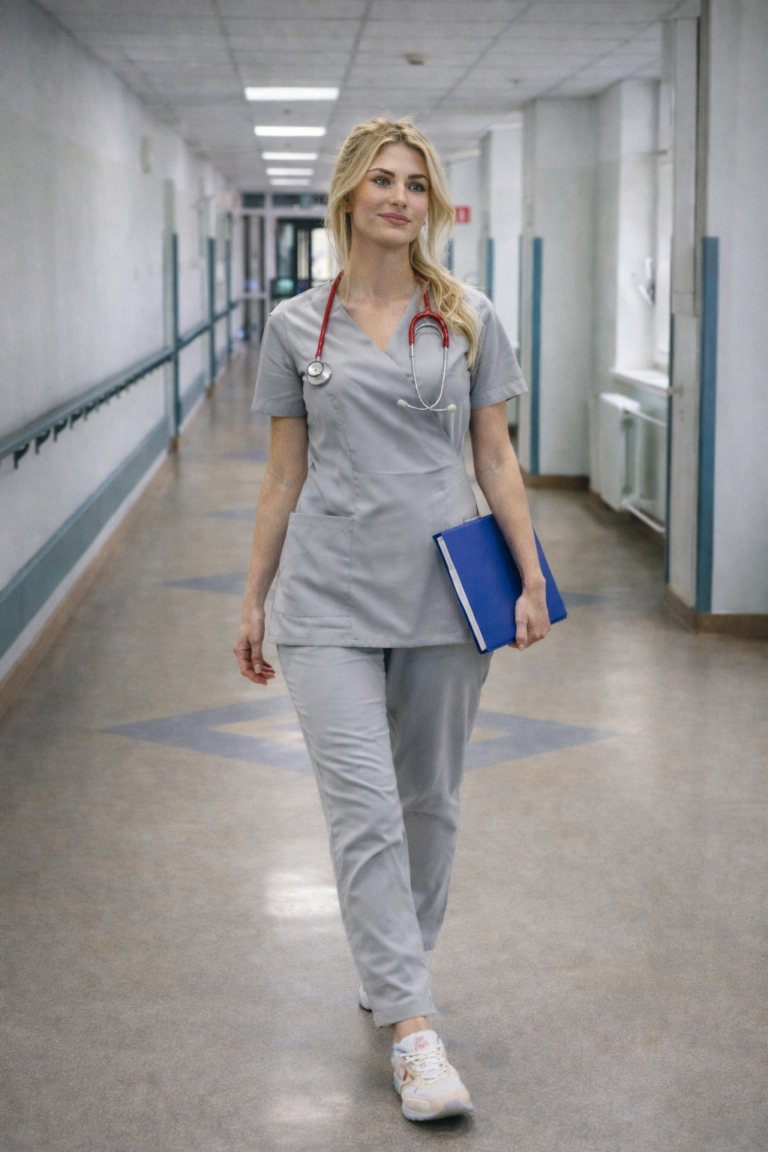
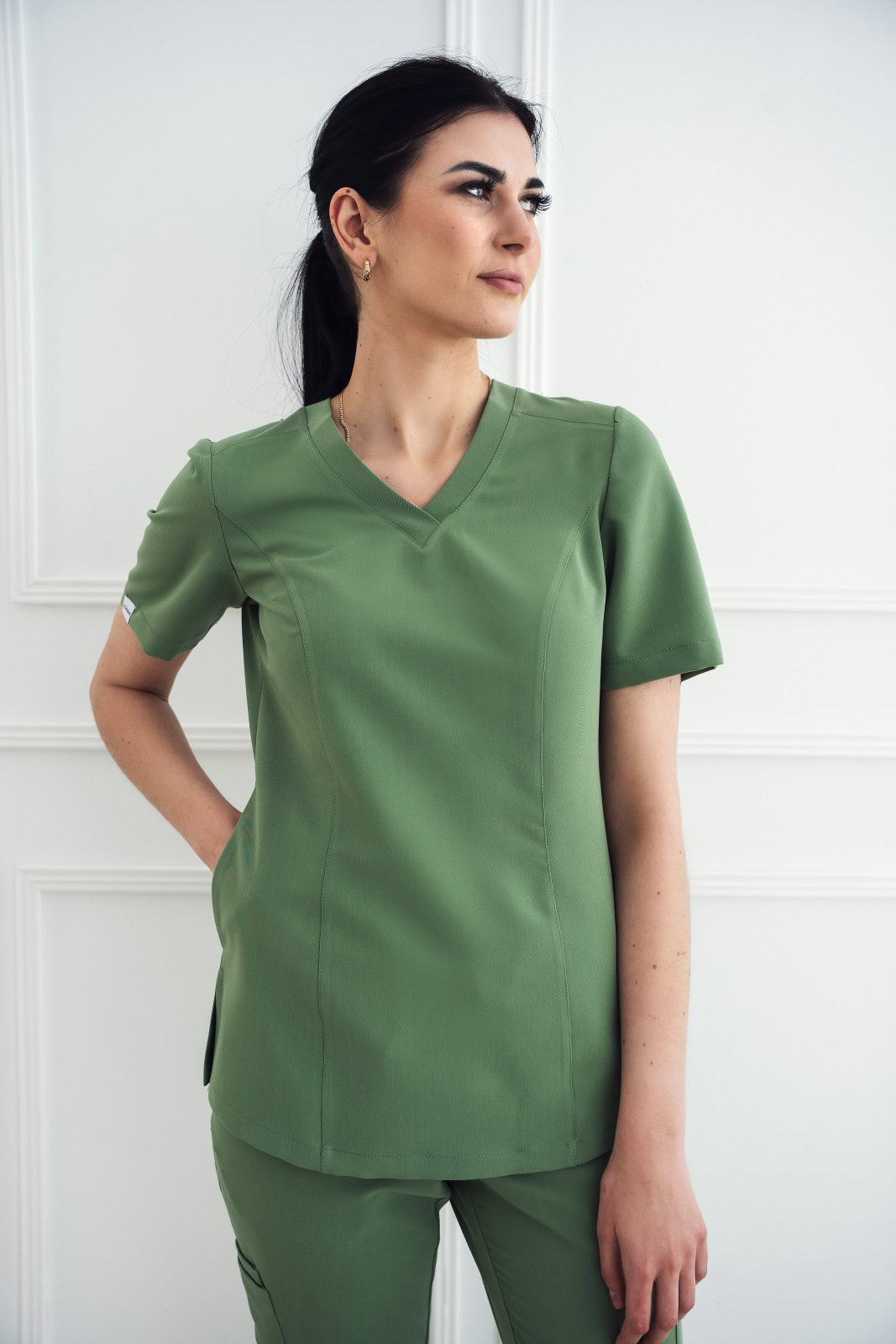
Working with acids is working with corrosive substances. Precision of application is crucial. Therefore, the cosmetologist must have complete freedom of movement. Professional cosmetic sweatshirt, made of flexible materials, allows precise manoeuvring of the brush around the client's eyes and mouth, without the risk of the rigid sleeve restricting movement at the crucial moment. Protecting one's own body from accidental acid splashing is also a priority here.
Chapter 3: Needle Mesotherapy - A Cocktail of Life for the Skin
It is the queen of revitalisation. No cream penetrates as deeply as a needle. The treatment involves the delivery of active substances directly into the dermis.
Step-by-step procedure
- Anaesthesia: Application of lidocaine cream under occlusion (film). Duration of action: 20-40 minutes.
- Disinfection: Key stage. The skin must be sterile.
- Injection: The cosmetologist makes hundreds of tiny punctures, leaving deposits of the preparation (lumps).
Measures used (Cocktails)
What is in the syringe?
- Uncross-linked hyaluronic acid: Strong hydration.
- Vitamins (A, C, E, B group): Nutrition.
- Amino Acids and Peptides: Building blocks for collagen.
- Coenzymes and Minerals.
Time and Recovery
- Treatment time: The injection itself takes 15-30 minutes (depends on the area: face, neck, décolleté).
- After treatment: There are visible „bubbles” (deposits) on the skin, which take 24 to 72 hours to absorb. Bruising (haematomas) may occur, which is normal with epidermal breaks.
Chapter 4: Micro-needle mesotherapy (Dermapen) - Mechanical stimulation
An alternative to the classic needle. Here, a device (pen) with pulsating needles (up to 2,000 punctures per second!) is used.
Mechanism of Action
The treatment works in two ways:
- Damage: Punctures are a signal to the brain: „There's a wound here! Repair!”. A cascade of growth factors and the production of new collagen is triggered.
- Penetration: Ampoules with active ingredients are introduced through the resulting tubules.
Job Specificity
The treatment is associated with bleeding (so-called „bloody dew”). This is a desirable therapeutic effect (release of growth factors from platelets). It requires the staff to maintain the highest standards of asepticism. The cosmetologist works with gloves, a mask, and his or her attire - clean, washed at the appropriate temperature cosmetic sweatshirt and comfortable cosmetic trousers - provides a protective barrier against contact with body fluids (blood).
- Recovery time: The skin is red and burning as after a sunburn for 24-48h. After 3 days, there may be a mild, „askew” 1TP1Squishing.
Chapter 5: Tissue Biostimulators - Skin Architecture
They have been an absolute hit in recent years. Biostimulators are not fillers (like cross-linked hyaluronic acid to alter facial features). They are preparations that force your skin to work at top speed.
Types of Biostimulants
- Polynucleotides: DNA/RNA fragments (often from salmon) that work at a cellular level to regenerate, hydrate and fight free radicals.
- Atelocollagen: Liquid collagen that fills in defects in the skin's structure.
- Calcium Hydroxyapatite / Polylactic Acid: Powerful stimulators that create a scaffold for new collagen, thickening the skin and producing a lifting effect.
Course of treatment
It is an injectable treatment, but the technique is different to that of mesotherapy. It often uses cannula (blunt needle), which is used to introduce the preparation from one or two insertion points, spreading it under the skin.
- Pain: Less than with mesotherapy (fewer punctures).
- Effects: They are not immediate. It takes 4-6 weeks for the skin to remodel and produce new collagen. The effect builds up over time.
Chapter 6: Hydrogen Purification and Hydrabrasion - A New Era of Purification
Forget painful „squeezing” (manual cleansing), which often ended in scarring. Today, water technology is king.
Hydrogen purification
It uses microscopic particles of active hydrogen, which are introduced under pressure deep into the skin.
- Objective: Hydrogen binds to free radicals, neutralising them (anti-aging action) and „sweeps” impurities from the pores.
- For whom: For everyone („banquet treatment”), especially for polluted, urban, smoker's skins.
Course of action (Multi-stage)
The treatment usually lasts 60-90 minutes and consists of several stages: cavitation peeling, hydrogen infusion, injection of active substances and a mask. It is completely painless and relaxing.
Chapter 7: Comfort of the Professional and Quality of Treatment (Ergonomic Aspect)
When describing treatments, we rarely think about the person who performs them. And this is a mistake. The quality of a treatment is directly correlated with the comfort of the cosmetologist.
Most procedures (mesotherapy, cleansing, acid work) require the professional to adopt a forced body position - bending over the treatment chair, precise wrist work, standing in one position for several tens of minutes.
Chapter 8: Lords of Light - Lasers and IPL
Laser therapy is one of the most rapidly growing fields. Lasers use the phenomenon of selective photothermolysis. What does this mean? A beam of light of a specific length „seeks” a specific target (chromophore) in the skin - e.g. melanin (hair), haemoglobin (capillary) or water - and destroys it with thermal energy, sparing the tissues around it.
1. Laser Epilation (Permanent Hair Removal)
This is the end of the razor era. The diode or alexandrite laser burns the hair root.
- For whom: For people with dark hair (the laser „cannot see” grey and light hair).
- Time and series: It requires a series (6-8 treatments every 4-8 weeks) because the laser only works on hair in the growth phase (anagen).
- Preparation: The skin must not be tanned! You must shave your hair with a razor the day before the treatment.
2. capillary closure (vascular lasers)
Target: haemoglobin. The laser „glues” dilated vessels (spider veins) or reduces erythema.
- Effect: Often immediate (the capillary disappears „before your eyes”).
- Recovery time: Possible swelling for 2-3 days.
3. Fractional Laser (Rejuvenation and Scars)
This is „heavy artillery”. The laser punctures the skin with thousands of microdamages (like a sieve), leaving bridges of healthy tissue from which rapid regeneration takes place.
- Ablative (CO2): Vaporises the epidermis. More drastic, but gives spectacular lifting and acne scar removal results.
- Recuperation: 5-10 days. The face is swollen, covered with scabs („tarka effect”). Requires a holiday.
- Non-ablative: Heats the skin without disturbing the epidermis. Gentler, requires more repetitions.
Operator safety: Working with the laser requires the absolute wearing of safety glasses by the client and the cosmetologist.
Chapter 9: Scalpel Free Lifting - HIFU and Radiofrequency
It used to be that to lift drooping cheeks („hamsters”), you had to go to a surgeon. Today, we have physics.
HIFU (High-Intensity Focused Ultrasound)
Concentrated ultrasound. They work deeply - at the level of the muscle fascia (SMAS), which is where the plastic surgeon operates.
- Mechanism: The ultrasound wave heats the tissue spot-on, causing it to shrink and stimulating collagen production.
- Perceptions: Quite painful („screw-in”, „hot needles”), but the procedure is a one-off.
- Effect: The full effect of the lift can only be seen after 3-6 months.
Micro-needle radiofrequency (RF)
A hybrid of two technologies: pricking (needles) and heating (radio wave).
- Mechanism: The needles penetrate the skin and a heat pulse is emitted at their ends. This results in a strong thickening of the skin.
- For whom: Sagging skin, scars, stretch marks.
Chapter 10: The Art of Precision - Permanent Make-up (PMU)
Permanent make-up (micropigmentation) is no longer a tattoo on the face. Today, it is the art of subtly enhancing beauty.
Techniques:
- Eyebrows: Powder method (Ombre Brows) or hair method (Microblading/Machine Hairstroke). Aim for a natural shadow rather than „black lines”.
- Mouth: Aquarelle Lips (watercolour effect) or contouring. They restore the redness of the lips that fades with age.
- Eyes: Eyelash line thickening or decorative eyeliner.
Mileage and safety
The treatment takes 2-3 hours. Requires surgical sterility.
- Preliminary drawing: Key stage of facial geometry.
- Pigmentation: Insertion of pigment into shallow layers of skin (shallower than a tattoo).
The role of the Specialist: The linergist spends hours in one forced position, bent over the client's face. Her hand must be as steady as a rock. Here comfortable ocosmetic equipment is the foundation. If the sleeve cosmetic blouses pulls with every hand movement, precision drops. If cosmetic trousers compress the abdomen when sitting on a hock, there is a discomfort that distracts. There is no room for error in the PMU - the hand cannot tremble.
Chapter 11: Framing the Eye - The Architecture of the Gaze
This is the fastest growing segment of „light” cosmetics.
Eyebrow and eyelash lamination
This is the permanent reshaping of hair using chemicals (thioglycollates).
- Eyelash lift: Curls lashes at the root. Opens the eye.
- Eyebrow lamination: Arranges unruly hairs in the desired direction. Gives a „fluffy brows” effect.
The treatments last about 60 minutes, are painless and give results for 4-6 weeks.
Chapter 12: The Expert Image - Why Does Your Attire Matter?
In the era of Hi-Tech technology, the beauty salon has ceased to be a place of „gossip” and has become a clinic. The client pays several thousand złot for a HIFU or fractional laser treatment. He expects quality at every level.
The image of the cosmetologist is the first signal: „It's professional and safe here.”.
1. Consistency with Technology
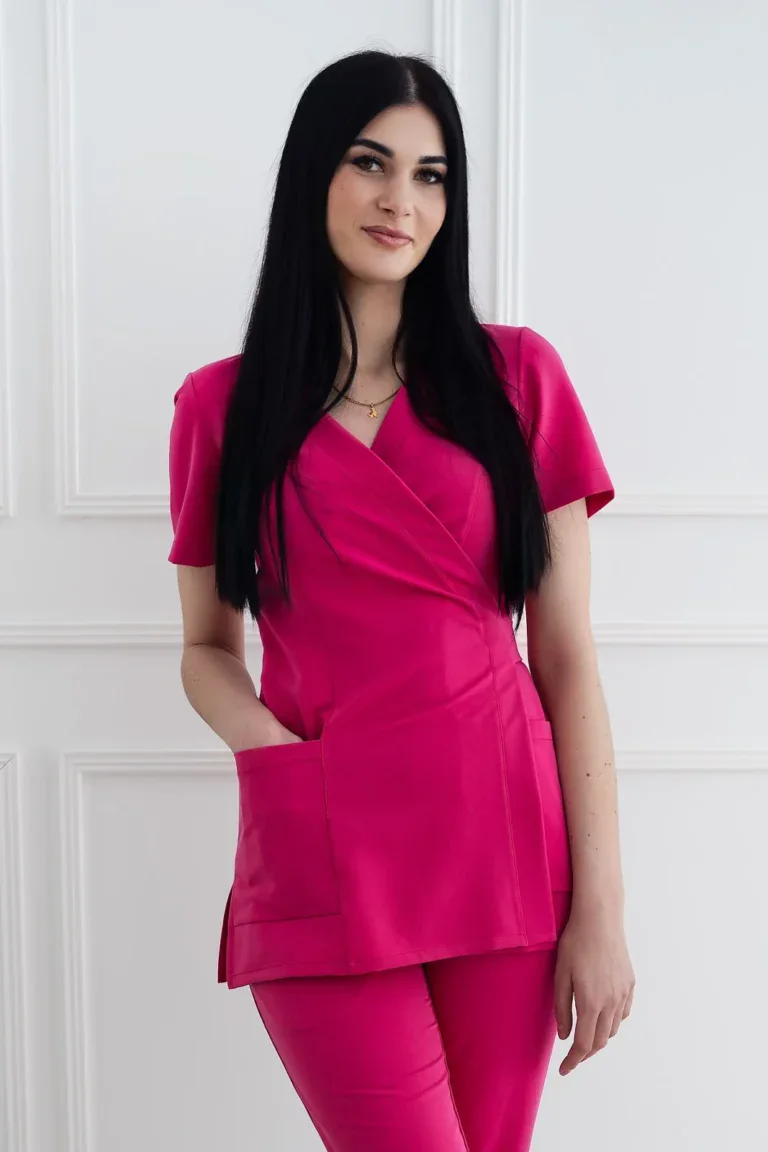
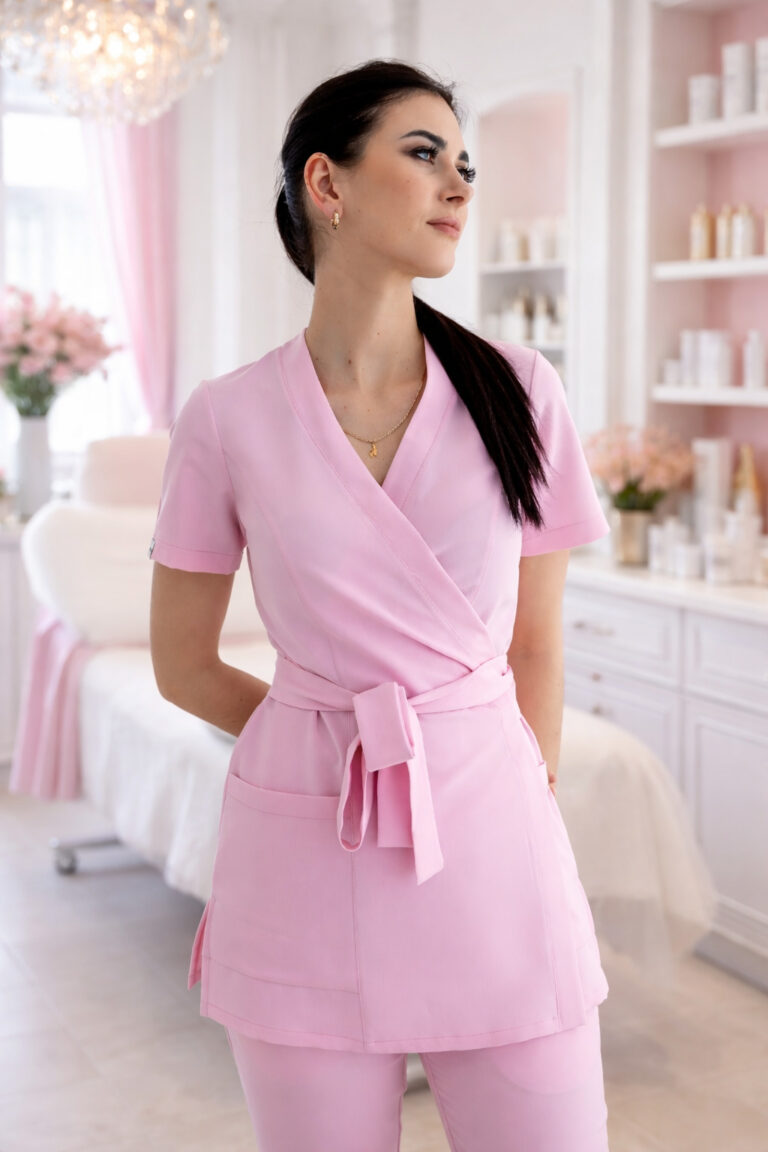
You can't operate a 200,000 złot laser in a pulled-out T-shirt and jeans. It's cognitive dissonance for the customer. Professional cosmetic sweatshirt with a modern cut (e.g. asymmetrical, with an elegant neckline), made of high-quality fabric, is an extension of competence. It states: „I am an expert, I care about standards”.
2. Hygiene and Health and Safety at Work with Lasers
Working with devices that emit heat, light or radio waves involves risks.
- Body protection: The outfit must cover the body, protecting it from accidental burning or chipping (e.g. with milling pedicures or ablative lasers, where epidermal particles become airborne).
- Material: Fabrics with a high polyester and viscose content are resistant to stains (e.g. from PMU pigments or acids) and easy to disinfect. Cotton absorbs everything like a sponge.
3. Ergonomics in multi-hour operations
Treatments such as eyelash extensions or complex full-body laser procedures take hours.
- Cosmetic trousers: They must be like a second skin. Jogger-type models with drawstrings and an elastic waistband allow you to change position freely (standing up, sitting down, leaning into the laser) without having to constantly adjust your clothes.
At Scrabme, we create garments that combine this „technological” design with „human” comfort. Because we know that a tired cosmetologist is a less precise cosmetologist.
Chapter 13: Holistic Przyszłość - Beauty & Wellness
przyszłości cosmetology is not just about „fixing the face”. It's a holistic approach. More and more surgeries are combining Hi-Tech treatments with:
- Supplementation: Nutraceutical therapies to support the skin from within.
- Research: Ordering hormone or food intolerance tests before treating acne.
- Wellbeing: Kobido, Zoga Face massages - a return to manual techniques that relax tense facial muscles and reduce stress.
We have come a long way - from chemical peels to mesotherapy needles to advanced lasers and ultrasound.
Modern cosmetology is a powerful field of science. It gives us tools to fight time and complexes that our grandmothers could only dream of. But let's remember - technology is just a tool in the hands of the czł human being.
The key to success is Expert. A trained cosmetologist who is able to select a therapy, take care of safety and... who takes care of his own comfort by choosing professional solutions.
Your skin is with you for life. Invest in it wisely, choosing quality over fads.
Inspired by the possibilities of technology? Don't look for treatments at „random”. Book a consultation with a reputable practice that will create a personalised Beauty Plan for you. Your skin is unique - its treatment should be too.
Do you run a practice? Investing in the best lasers and training? Ensure that your image is consistent with the quality you offer. Discover the Scrabme beauty wear collection. Our cosmetic blouses i cosmetic trousers combines modern design with the ergonomics you need when working with technology for hours on end.
Why does dress matter?
If the cosmetologist's apron „drinks” under his armpits, or his trousers put pressure on his abdomen when bending over, his concentration drops. Muscular tension, hand trembling and fatigue appear.
- Cosmetic trousers (Joggers): Modern cosmetic trousers The jogger type with elastic waistband and drawstring allows you to move freely around the chair, squat at the lower cosmetics shelves or sit comfortably on the hocker.
- Cosmetic Tunic: It must be made of breathable material (viscose blend). When working under a magnifying lamp and with heat-generating devices (lasers) on, thermal comfort is crucial so that the specialist does not sweat over the client's face.
At Scrabme we understand that cosmetic clothing is a working tool. The more comfortable the specialist feels, the more precise and safer the treatment is for you.