
We live in an age of artificial intelligence, flights to Mars and 3D bioprinting. We can transplant a face, print a heart valve and operate on a patient on the other side of the world with a robot. And yet, despite these gigantic technological advances, there is one drug that, to this day, no laboratory in the world has been able to produce. A drug that has no substitute. A drug whose only source is the second człowiek.
That drug is blood.
Thousands of operations are carried out in Poland every day. Traffic accident victims, oncology patients, women giving birth, people after transplants - their lives hang on a thin thread held by an anonymous donor. The decision to donate blood is an act of supreme humanity. It is a quiet heroism that does not require a cape, but merely an outstretched hand.
In this comprehensive guide, we will take you on a journey through the fascinating world of blood donation. We will dispel myths, walk you step by step through the procedure at the Regional Centre for Blood Donation and Haemotherapy (RCKiK), look at donor privileges and see how Poland compares to other countries. You will also see the important role played in this process by medical personnel and their professional medical scrubs, which are a guarantee of sterility and safety.
Chapter 1: Biology and Meaning - Why is Blood So Important?
To understand the importance of blood donation, we need to look inside our bodies. Blood is not just a red liquid. It is a fluid tissue, a highway of life that transports oxygen, nutrients, hormones and immune system cells.
What do patients really need?
When you donate whole blood (450 ml), it rarely reaches the patient in this form. Modern medicine is based on the components of blood. Your donation is separated into:
- Red blood cell concentrate (RBC): It is „fuel”. Essential for haemorrhages (accidents, operations) and severe anaemia. Without it, the body suffocates.
- Plasma (FFP): The liquid part of the blood, rich in clotting factors. Saves lives in burns, shock and clotting disorders.
- Platelets (KKP): „Patches” of the body. They are absolutely crucial for cancer patients, especially after chemotherapy and with leukaemia, when the bone marrow stops working.
One donation - three lives
Through this process of separation, one visit to a blood donation centre can save the health or life of up to three different people. This is the mathematics of good that is second to none.
Chapter 2: Who can become a donor? (Qualification Screen)
Many of us want to help, but the overriding principle in blood donation is safety - for both the recipient and the donor. Polish regulations are restrictive, but necessary.
Basic requirements (Base)
In order to even think about donating blood in Poland, you must meet the „holy trinity” of conditions:
- Age: 18 - 65 years.
- Weight: Minimum 50 kg (this is a donor safety issue - losing 450 ml at a lower weight could be a shock to the body).
- Document: Identity card (or mCitizen) with PESEL number.
Temporary Disqualification - When Must You Wait?
Most people drop out at this stage. You cannot donate blood if:
- In the last 6 months: You have had a tattoo, piercing, acupuncture or had a surgical/endoscopic procedure (risk of hepatitis B and C).
- In the last four weeks: You have had an infection, a fever, taken antibiotics.
- In the last 3 days: You have had a dental procedure (e.g. tooth extraction).
- Women: They cannot donate blood during menstruation (and 3 days after), during pregnancy and during lactation.
Permanent Disqualification - Who Can't Donate Blood?
There are diseases that exclude for life. These include cardiovascular diseases (history of myocardial infarction, coronary heart disease), serious kidney disease, diabetes, cancer, infectious diseases (HIV, hepatitis B/C, syphilis) and autoimmune diseases.
Chapter 3: The Donor Pathway - Step by Step through the RCKiK
For someone going for the first time, a visit to a blood donation centre can be stressful. Let's dispel that stress with knowledge. Here's what the process looks like, minute by minute.
Step 1: Registration and Survey
You enter the RCKiK. The first step is to register. Then you receive a very detailed questionnaire. The questions are about your health, travel (tropical countries?), risk behaviour and medication you take.
- Golden rule: Lying in a survey is a crime against the health of the recipient. Be brutally honest.
Step 2: Laboratory (Preliminary Verification)
A blood sample is taken from a finger or vein. The haemoglobin level is checked. If it is too low (anaemia) - you go home.
Step 3: The Doctor's Surgery
The doctor analyses your questionnaire and results. He listens to your chest and measures your blood pressure. He or she makes the final decision: „Fit to donate blood”.
Step 4: Intake room
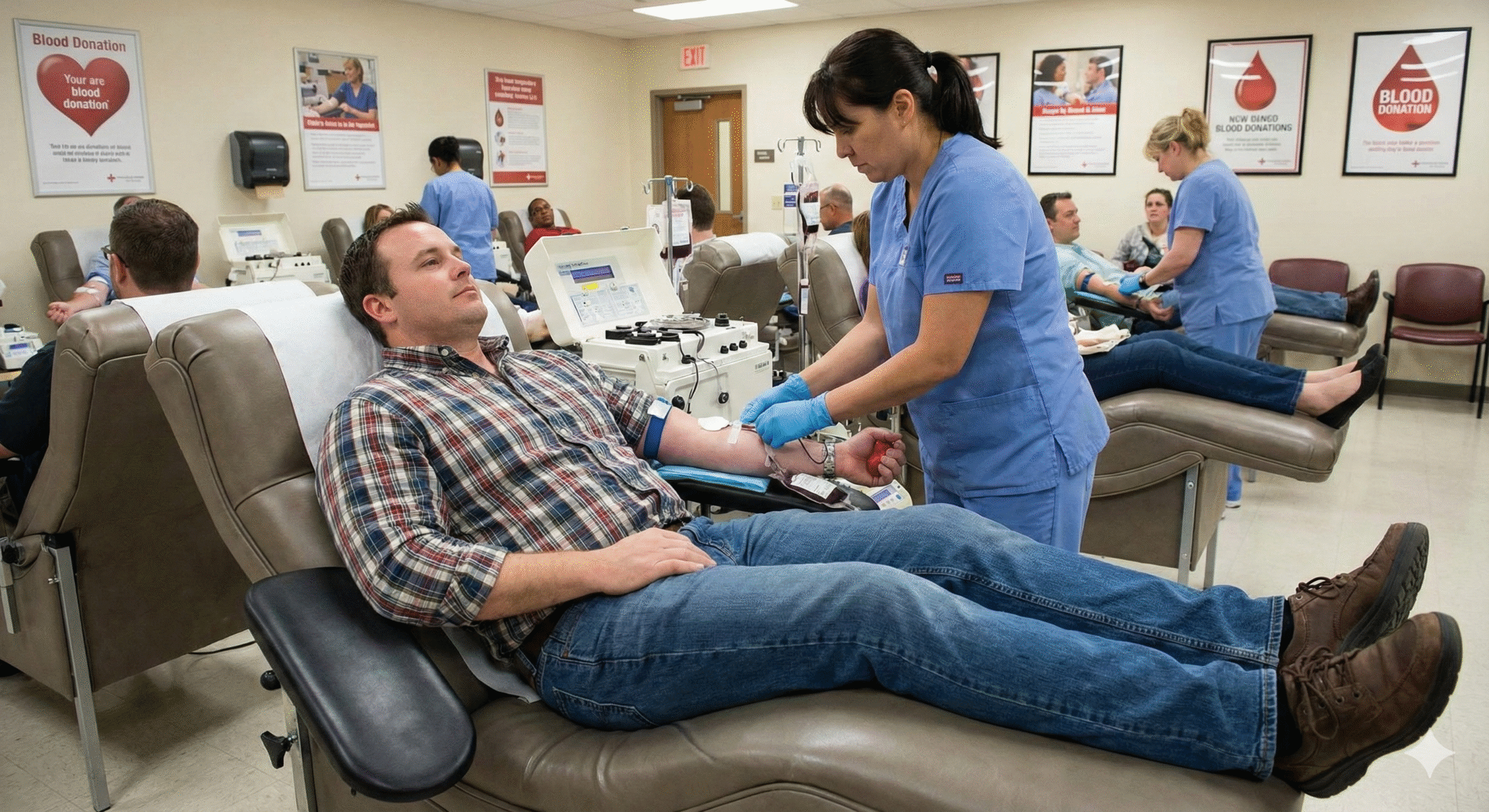
This is where the magic happens. You sit down in a comfortable chair. The medical staff - nurses and nurse practitioners - attend to you. This is the moment to pay attention to their professionalism.
In the sterile conditions of the intake room, hygiene is a priority. Staff are dressed in professional medical uniforms. Why is this important? Because medical scrubs made of certified materials provide a protective barrier. Clean, tidy medical suit staff builds donor confidence - you know you are in a safe, sterile place.
The collection of whole blood itself (450 ml) takes just 5-10 minutes. It is painless (apart from the prick).
Step 5: Regeneration
After donating blood, you have to rest for 10-15 minutes. You are given a recovery meal (the famous chocolates), a drink and advised to take it easy for the rest of the day.
Chapter 4: Poland and the World - Fascinating Cultural Differences
Blood donation is a universal need, but systems in different countries vary dramatically. Poland has one of the most „appreciative” systems in the world.
Polish Model: Honorable and „Chocolate”
In Poland, blood donation is generally honorary and free of charge. We do not pay for blood (with the rare exception of donors with rare groups undergoing immunisation treatments). In return, the state offers a package of privileges:
- 2 days off: The day of the blood donation and the following day are non-working/study days in Poland, paid in 100%. This is a worldwide phenomenon.
- Calorie equivalent: The famous 8-9 chocolate bars (4500 kcal).
- Tax benefits: Deductibility of donation (blood) from income in PIT.
- Rail discounts: After donating 3 donations during the pandemic (or the corresponding amount during normal times), the donor is entitled to a 33% discount on tickets.
- Public transport: In many cities, Deserved Honorary Blood Donors (after donating 15/18 litres) ride for free.
German and Austrian Model: Mixed Model
In our western neighbours, the situation is different. In Germany and Austria, so-called financial compensation (Aufwandsentschädigung) is allowed in the private sector. This means that in some outlets you can receive cash (around €20-30) for donating blood or plasma. This is subject to ethical discussions, but effectively increases the supply of plasma for the pharmaceutical industry.
US model: Plasma business
The United States is a giant in the production of blood-based medicines. There, plasma donation (plasmapheresis) is often seen as a way to make money. „Selling plasma” is common among students or lower-income people. The US supplies about 70% of the world's plasma used for drug production. Whole blood donation (for transfusion) is usually honorary (Red Cross).
The Swedish Model: SMS with Life
Sweden has introduced an ingenious incentive system. The donor receives an SMS at two moments:
- Acknowledgement right after the blood donation.
- Notification when his blood is physically used to save a life. A message stating: „Your blood just saved someone's life”.” is a more powerful motivation than any money.
Chapter 5: Types of Donation - Not Just „Whole Blood”
Most of us associate blood donation with donating 450 ml of the red liquid (Whole Blood). But this is not the only option. Advanced technology allows only selected components to be collected.
Apheresis (Separation)
During this procedure, the blood from the vein goes into a special machine (separator). The machine separates the necessary component and „returns” the rest of the blood to the donor.
- Plasmapheresis (Plasma): It can be donated much more frequently (even every two weeks!), as the body quickly regenerates fluids and proteins. Approximately 600 ml of plasma is collected.
- Thrombapheresis (Platelets): The procedure takes longer (about 60 minutes), but allows as many platelets to be obtained from one donor as would normally be obtained from five whole blood donors. This is invaluable for leukaemia patients.
During these long procedures, the comfort of the staff operating the separators is crucial. Nurses spend many hours at the machines and donors. Therefore, their medical scrubs for women must not only be aesthetically pleasing, but above all comfortable and breathable (viscose!) to ensure thermal comfort in air-conditioned apheresis rooms.
Chapter 6: Women in Blood - Strength and Delicacy
Statistics show that men donate blood more often in Poland. This is due to biology (women have natural cycle-related iron losses and lower haemoglobin levels) and limits (women can donate whole blood four times a year, men six times).
However, the role of women in blood donation is invaluable - not only as donors, but as staff. 80% of the staff at the RCKiK are women - doctors, nurses, laboratory technicians.
They are the ones who take care of the atmosphere. They are the ones who can poke into the vein so that „the mosquito bites harder”. Their professionalism is built up by years of experience, but also by their image. Modern, colourful medical scrubs (e.g. in Sweet Pink, Latte or Green) replaced the old, stiff aprons. As a result, blood donation centres have ceased to be associated with hospital trauma and have become modern and friendly places.
The sight of a smiling nurse in an elegant medical tunic or comfortable joggers makes the stress of the needle diminish. At Scrabme, we are proud to dress these quiet heroines who roll through litres of life every day.
Chapter 7: Myths and Facts - Dispelling the Fears
There are many legends surrounding blood donation. Let's dispel them once and for all.
Myth 1: „Donating blood is addictive and the body produces too much blood.” FACT: Absolute nonsense. The body produces as much blood as it needs. After donation, it regenerates to baseline levels and the process stops. There is no „overproduction”.
Myth 2: „I can get infected while donating.” FACT: Impossible. The equipment used is disposable, sterile and opened with you. Staff use gloves and take care with procedures (which is why clean medical uniforms).
Myth 3: „It hurts a lot.” FACT: The pain is comparable to a pinch. The needle is slightly thicker than for a normal blood test (so as not to damage the blood cells), but experienced staff do it in no time.
Myth 4: „I will be weak for a week after donating blood.” FACT: Most people return to normal functioning after a few hours. You replenish your fluid volume by drinking water and your blood cells regenerate within a few weeks without affecting your daily life.
Chapter 8: Blood Groups - Who Do We Need Most?
We often hear appeals for group „0 Rh-„ blood. Why?
- Group 0 Rh- (Universal Donor): Its blood cells have no A, B or Rh factor antigens. It can be transfused to anyone in a life-saving situation when there is no time for cross-matching. It is the most valuable blood in rescue.
- Group AB Rh+ (Universal Recipient): It can accept any blood.
- Your Group: What is needed most is blood... blood that is in short supply. Blood banks need to stock all groups. Don't think: „I have a popular type, so I'm not going”. It is precisely because it is popular that most patients need it!
Curiosity: There is a „Golden Blood” (Rh null) - a blood type that does not have any of the 61 antigens of the Rh system. Only about 40 people worldwide have it.
Summary: Become an Everyday Hero
Blood donation is more than a medical procedure. It is a demonstration of social maturity and empathy. It is knowing that there is a medicine flowing through your veins that can make someone's father, mother or child come home.
You don't have to be a superhero from a comic book. All you need to do is eat a light breakfast, hydrate yourself and go to your nearest RCKiK. There you will meet a professional team who, in their impeccable scrubs will ensure your comfort and safety.
Two chocolates you'll eat alone, the rest you'll give away to your friends. But the satisfaction of having saved a life - that one will stay with you forever.
Not sure where your nearest collection point is? Check on blood donors.org or your local RCKiK. Share this article - maybe you will make someone decide to take that first step?
Do you work at the RCKiK, dialysis station or ward? Your work requires the highest standards of hygiene and comfort. Check out the Scrabme medical wear collection. Our medical scrubs for women and men's are designed so that you can focus on what matters most - saving the health of others.